 Email:
  Tel:+86-13486478562
 Language
  Español
 Português
Product Consultation
Your email address will not be published. Required fields are marked *
Color that survives humidity, cleaning chemistry, and daily handling is decided long before the chamber door closes.
Bathroom fittings makers do not invest in a PVD coating machine to make parts look expensive. They invest to stop finishes from fading, peeling, and failing salt spray tests after a few months in service. The difference between a surviving coating and a failing one is rarely the color on the target material. It is the machine configuration, the pre-treatment line, and the way batches are loaded.
In short: durable PVD finishes on faucets, shower heads, handles, and accessories come from dense film growth, controlled substrate temperature, and genuinely clean surfaces. A machine built around those three conditions reduces rejects and warranty claims from the first batch.
Bathroom hardware lives in a punishing environment: high humidity, thermal cycling, hard water deposits, soap residue, and cleaning products containing chlorine, citric acid, or abrasives. A decorative coating on a faucet body must resist all of them while keeping a uniform metallic appearance.
PVD films for bathroom finishes are thin — commonly 1 to 3 micrometers. At that thickness, performance has nothing to do with bulk thickness. It is determined by density, adhesion, and chemical inertness. These properties are judged by neutral salt spray exposure for 48 to 96 hours, boiling water adhesion checks, and abrasion testing with a CS-10 wheel.
Well-deposited multi-arc or sputtered films typically reach 1500 to 2500 HV, show no micro-peeling at edges, and keep color within a measured tolerance after exposure. They separate a faucet that stays champagne gold for years from one that turns patchy near the drain area.
A PVD film is measured in microns, but its commercial value is measured in warranty claims avoided.
This combination of appearance and endurance belongs to the larger group of decorative PVD coating applications that production teams rely on for metal, ceramic, and plastic bathroom components.
Two deposition technologies dominate bathroom hardware production: multi-arc ion plating and magnetron sputtering. They are often presented as alternatives, but they answer different questions. Multi-arc ion plating produces dense, highly adherent films and works well on complex three-dimensional shapes such as faucet bodies, valve handles, and shower arms. Its main drawback is micro-droplets, which can roughen the surface if target quality is not controlled.
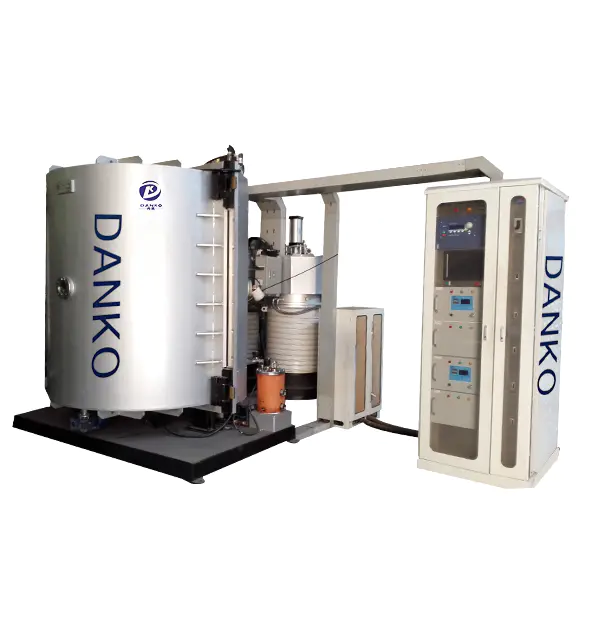
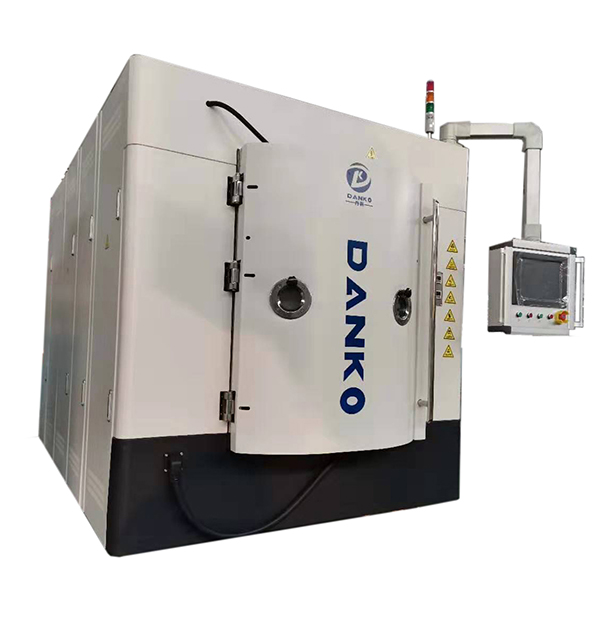 PVD Vacuum Coating System for Sanitary Ware DecorationThis PVD system is positioned for bathroom hardware where dense, adherent films matter. It suits complex three-dimensional parts like faucets and valve handles, complementing the article's discussion of multi-arc ion plating.View Product →
Magnetron sputtering produces smoother films and preserves the original surface texture of brushed or polished stainless steel. It is the preferred route for large flat pieces, shower panels, and decorative trim where surface consistency matters more than deposition speed. The trade-off is lower deposition speed and stricter target and gas distribution.
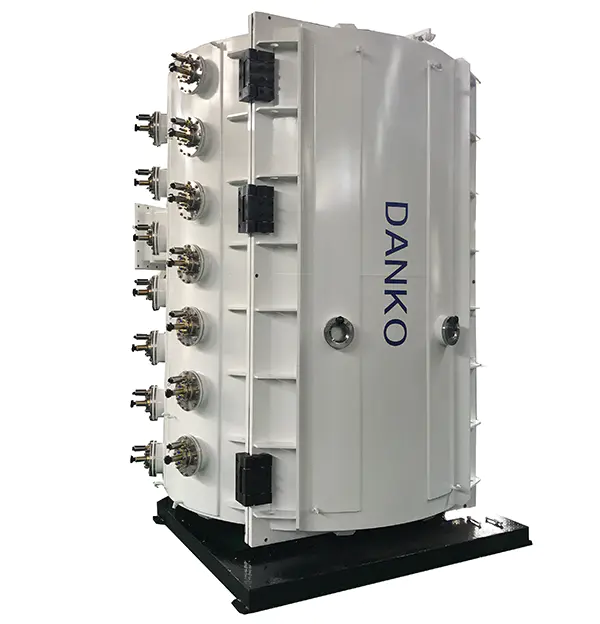
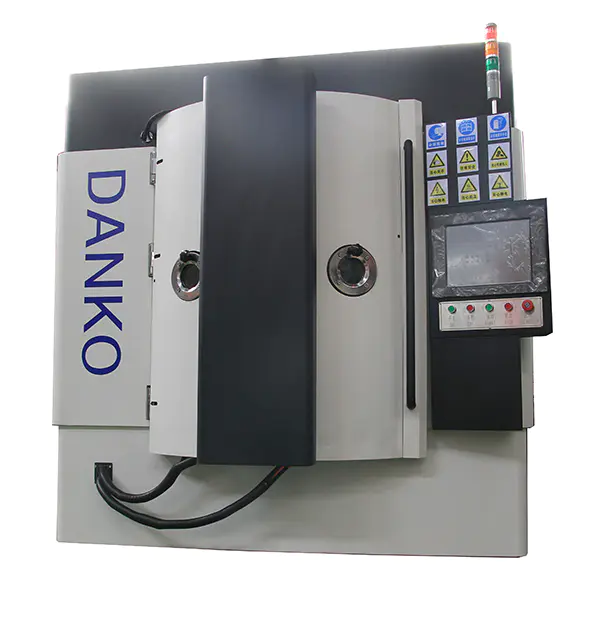 MF Magnetron Sputtering Coating Equipment for Flat SubstratesThis magnetron sputtering machine addresses the need for smooth films on large, flat items such as shower panels and trim. It balances film quality with deposition speed, fitting the article's comparison of coating technologies.View Product →
For a mixed bathroom product line — cast faucets, tubular shower frames, flat escutcheons, stamped handles — many manufacturers run both technologies, or choose one after mapping each part family. A supplier that offers both process types simplifies that decision, because the same coating recipe can be validated on parts with very different geometry.
| Evaluation factor | Multi-arc ion plating | Magnetron sputtering |
|---|---|---|
| Film density | High | Medium to high |
| Adhesion on three-dimensional parts | Excellent | Good |
| Surface smoothness | Moderate | High |
| Typical bathroom parts | Faucets, valve bodies, shower arms | Panels, flat trim, brushed stainless parts |
| Deposition rate | Higher | Lower |
| Main process concern | Droplet control | Target and gas distribution |
The champagne gold, rose gold, gunmetal, and brushed nickel finishes are not paints. They are compounds formed at the substrate surface: titanium nitride for gold, zirconium-based films for champagne and bronze tones, chromium-based layers for silver-gray, and carbon-containing films for black. The visible color depends on the target metal, reactive gas, gas flow, and bias applied to the workpiece — simultaneously.
That is why color consistency reveals the quality of a coating system more than any other single factor. A chamber with reliable mass flow controllers, stable pumping, and clean seals holds the same conditions batch after batch. A chamber with even a small air leak behaves differently at the start and end of a shift.
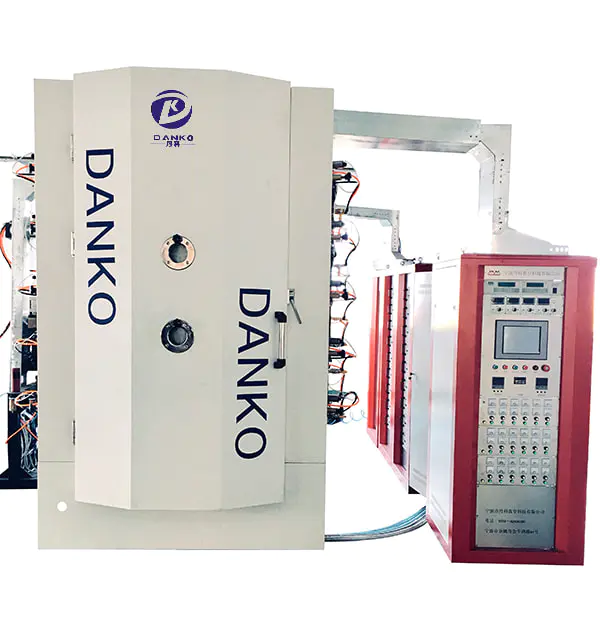
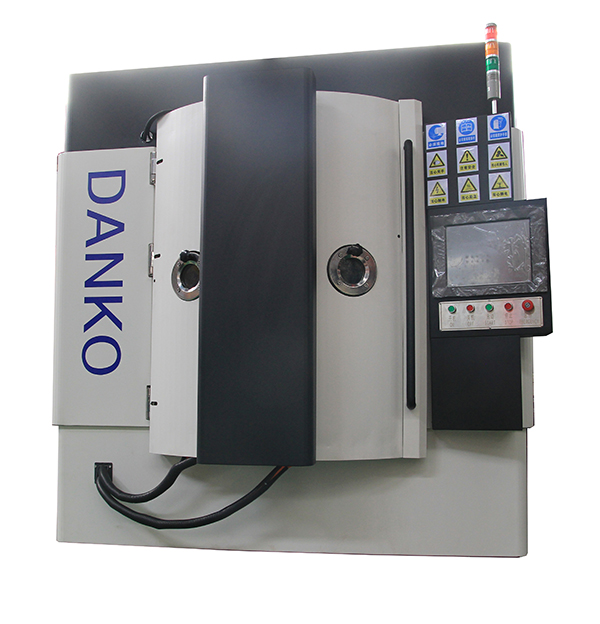 Hardware Decoration PVD Vacuum Coating Machine for Color ConsistencyTied to the article's focus on color uniformity, this machine emphasizes stable vacuum conditions and efficient material use. It is relevant for production batches where repeatable decorative finishes across hardware parts are essential.View Product →
InfoMeasure color on decorative hardware with a spectrophotometer set to CIELAB values under a D65 light source. A production tolerance of ΔE ≤ 1.5 against the approved master sample is realistic; demanding tighter values without controlling the substrate finish will make the line very difficult to run.
Substrate finish matters just as much as the chamber. A brushed surface with an unstable Ra value will appear different under the same coating, because the film is thin enough to follow the surface texture. For consistent color, control the surface preparation before the part enters the chamber, including the final polishing step and cleaning rinse.
Once the part mix and target colors are defined, selection narrows to configuration. Start with chamber geometry: long shower rails and large panels require depth and height that compact machines do not offer. Then examine the rotation system — planetary or multi-axis rotation keeps coating thickness uniform, while static loading creates visible front-to-back variation on complex parts.
Vacuum performance deserves special attention. The pumping package — oil diffusion pumps or turbomolecular pumps with rotary vane or roots backing pumps — determines both cycle time and film quality. Air leaks show up as muddy colors, poor adhesion, and process drift. Run a leak-up test as an acceptance check; production teams that skip it usually discover the problem during the first color audit.
WarningCleaning is not a postscript. The most expensive coating chamber will produce adhesion failures if the pre-treatment line cannot remove drawing oils, fingerprints, and polishing residue. Verify the cleaning line before commissioning the coating machine.
The coating machine itself is often 40 to 50 percent of the true project cost. The rest sits in the cleaning line, drying oven, racking stations, target inventory, process development, and quality control. Facilities that plan the full investment enjoy a smoother commissioning than those that add components later.
Running costs are equally predictable: target consumption, reactive gases, electricity, vacuum pump oil, and routine maintenance. As production volume grows, the consumable and energy share of the coating cost per piece settles into a stable figure that can be modeled before the purchase.
SuccessA mid-size fittings plant running roughly 2,000 plated pieces per day can reduce surface-finish rejects from 6–8 percent to 1.5–2 percent with a validated PVD process and the same part-handling staff. On an average order value of a few dollars per piece, the savings typically repay the coating line investment within 18 to 30 months.
Two budget mistakes repeat across companies. The first is under-specifying the vacuum pump package to save purchase cost, which extends every cycle and lowers color repeatability. The second is buying a machine without process support; decorative PVD is not a set-and-forget operation during the first months of production.
DangerAn undersized vacuum pump does not merely slow the cycle. It raises base pressure, shifts reactive gas ratios, and makes every batch slightly different. That is how a budget machine ends up costing more in gas, rework, and missed deliveries.
Before choosing a configuration, map your parts against the equipment range offered by the supplier and define acceptance limits together with your process team.
PVD for bathroom hardware is no longer a niche alternative. It is the standard answer to questions about environmental compliance, wear resistance, and aesthetic consistency. The manufacturers that get it right do not begin with a machine. They begin with a finish specification, test their own parts under real conditions, and only then choose a coating system that can hold the process window batch after batch.
That sequence — specification, validation, and machine selection — is exactly the order a competent equipment builder should guide you through. When the coating survives the bathroom test, everything else in the line becomes easier.
Your email address will not be published. Required fields are marked *

 Tel: +86-13486478562
 FAX: +86-574-62496601
 Email: [email protected]
 Address: No. 79 West Jinniu Road, Yuyao, Ningbo City, Zhejiang Provice, China
 OEM/ODM PVD Coater Manufacturers