Product Consultation
Your email address will not be published. Required fields are marked *

Coating Equipment
Two different machines hide behind one search term, and choosing the wrong family costs far more than choosing the expensive one.
A tool shop that needs three micrometres of aluminium titanium nitride on 8 mm end mills will never get there with a plasma spray torch. A foundry coating two-metre exhaust components with 250 micrometres of zirconia will not get there with an arc evaporation chamber either. Both processes are plasma ceramic coating, both are sold under that name, and that is why so many first quotations are technically correct and commercially useless.
The decision rule comes first: fix the coating thickness, the substrate temperature limit and the part geometry before reading any quotation. Those three variables eliminate one process family almost immediately. Chamber size, cathode count, pump stack and price are details that can be negotiated afterwards.
In vacuum plasma deposition, plasma is not the coating. It is the transport medium. A cathode is struck by a low-voltage, high-current arc in multi-arc ion plating, or bombarded by magnetically confined gas ions in sputtering, and the vapour leaves the source already ionised. In cathodic arc sources the ionisation fraction is high enough that most of what reaches the part arrives as charged particles rather than neutral atoms.
Charged particles are the reason the film is dense. A negative bias on the substrate holder, typically 50 to 200 volts, accelerates those ions into the surface with tens to a few hundred electron volts of energy. That impact packs the growing layer, closes porosity and anchors it to the substrate. Add a reactive gas and the metal plasma becomes a ceramic compound on the surface: nitrogen for TiN, CrN and AlTiN, acetylene for DLC and TiCN, oxygen for aluminium oxide and zirconium oxide.
The same plasma cleans the parts. Before deposition begins, an argon ion bombardment step sputters away oxide layers and residues at the atomic level. Adhesion failures are traced back to this stage far more often than to the coating itself, particularly on stainless steel and hardened tool steel.
A quotation that says only "PVD coating machine" hides a tenfold difference in film thickness and several hundred degrees of difference in substrate temperature.
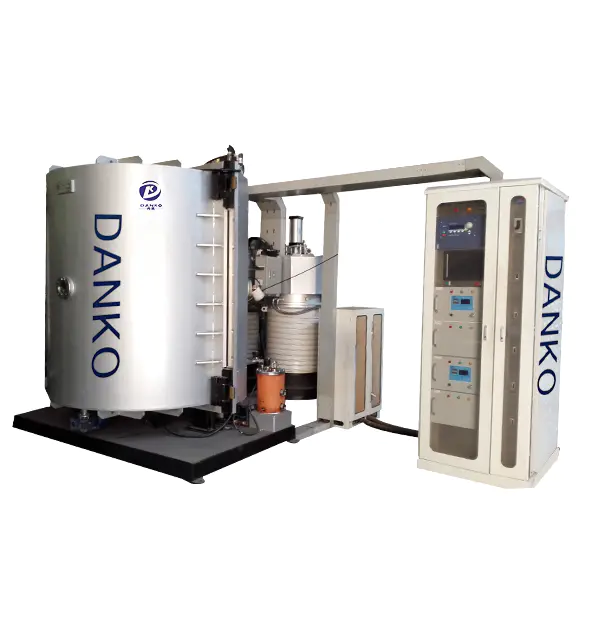
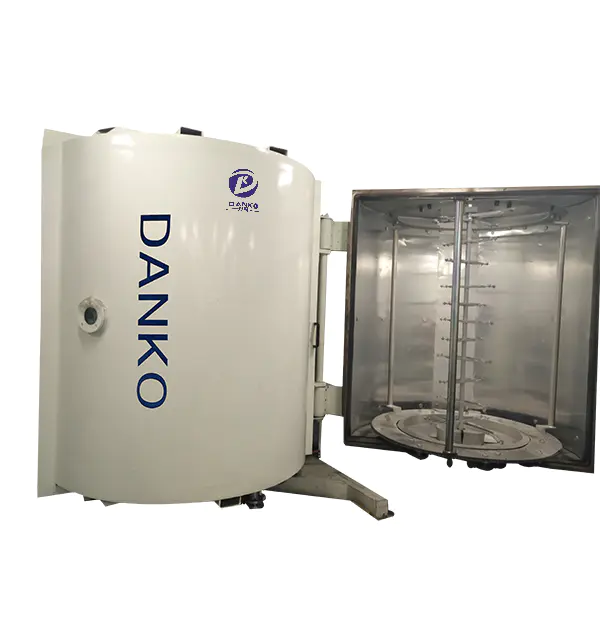
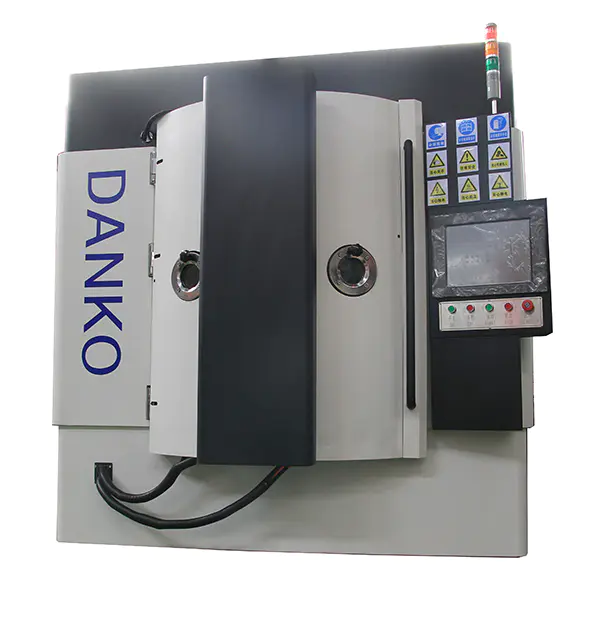
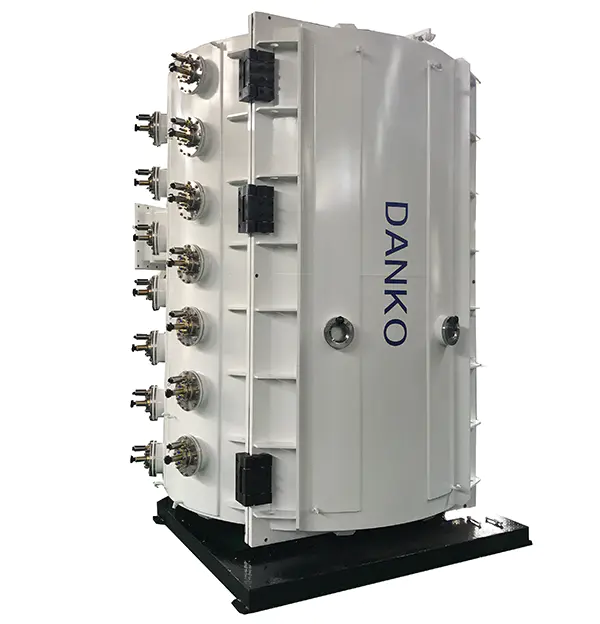
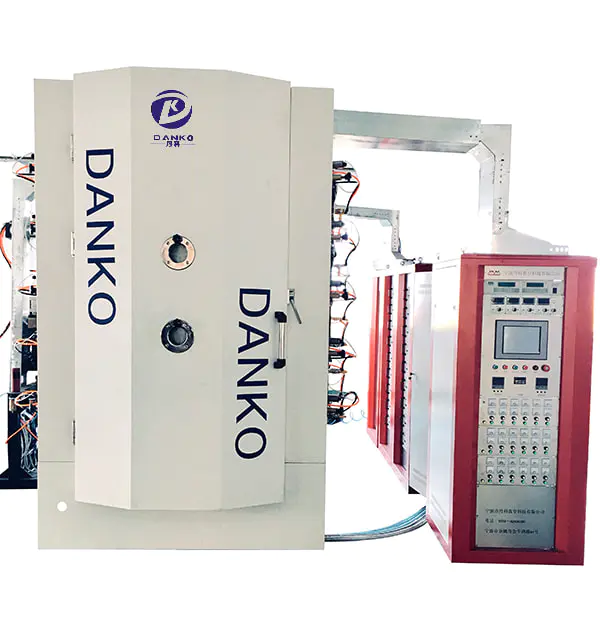
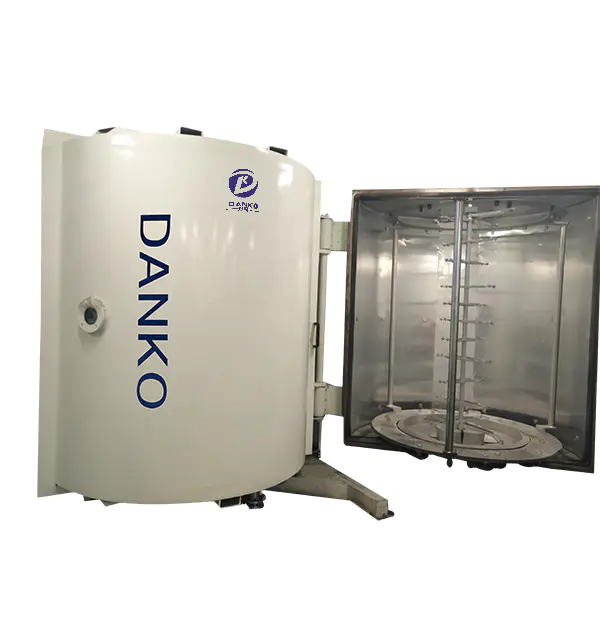
For nitride ceramics on tools, moulds and wear parts, multi-arc ion plating remains the workhorse, because deposition rates are high and the ion energy is built into the process rather than added afterwards.
The two families are often presented as alternatives. They are not competitors so much as different answers to different questions about thickness, temperature and finish.
| Criterion | Plasma spray (APS) | Multi-arc ion plating | Magnetron sputtering |
|---|---|---|---|
| Typical ceramic film | Al2O3, ZrO2, Cr2O3, YSZ | TiN, CrN, AlTiN, TiCN, DLC | Al2O3, ZrO2, TiO2, ITO |
| Film thickness | 100 to 500 micrometres | 1 to 6 micrometres | 0.05 to 5 micrometres |
| Substrate temperature | 300 to 500 degrees Celsius and above | 200 to 500 degrees Celsius, controllable | 100 to 300 degrees Celsius |
| Coating structure | Lamellar, 3 to 8 percent porosity | Dense, columnar | Dense, very smooth |
| Finish as coated | Rough, usually ground afterwards | Usable, polishable | Mirror-like |
| Part size | Very large parts possible | Limited by the vacuum chamber | Limited by the vacuum chamber |
| Common uses | Exhaust parts, turbine seals, pump liners | Tools, moulds, gears, medical parts, hardware | Optics, displays, oxide barrier layers |
The third and fourth columns are both vacuum processes, but they are not interchangeable. Arc sources deposit faster and hold adhesion on complex geometry. Sputtering sources deposit more slowly yet produce smoother films and far better control over oxide stoichiometry. If the part carries a mirror finish requirement or the film must be optically clear, sputtering wins. If it is a drill bit or a mould insert, arc usually wins on cost per part.
Once the process family is settled, the specification sheet becomes a short list of items that genuinely change what the machine can do for your parts.
For oxide ceramics such as Al2O3, ZrO2 and transparent conductive oxides, the specification conversation shifts away from hardness and towards stoichiometry, because the film has to be electrically or optically correct rather than simply wear resistant.
Ceramic PVD films earn their cost where three conditions overlap: wear or corrosion shortens part life, the surface finish matters, and the part cannot survive spray temperatures or an electroplating line.
A 2 to 4 micrometre AlTiN or TiCN layer extends the service life of end mills, drills and forming dies well beyond what uncoated or unhardened steel delivers, and it is applied at temperatures that leave the tool heat treatment intact. The arithmetic is straightforward: one machine can treat thousands of tools a month for a fraction of what a new grinding cell costs.
Bearings, gears, spindles and screw compressor rotors benefit from low-friction DLC or wear-resistant CrN. Here the limiting factor is usually tempering. If a part was tempered at 200 degrees Celsius, the coating cycle has to stay below that, which pushes the specification towards arc or sputtering with tightly controlled bias heating.
Surgical blades need a coating that does not blunt the edge, so 1 to 3 micrometres is the practical window. On the decorative side, anti-fingerprint and coloured ceramic layers on sanitary ware, tableware, watchbands and architectural hardware depend on batch-to-batch colour consistency far more than on maximum hardness.
A vacuum plasma system is a production asset, so the number that matters is cost per coated part, not the invoice. Two quotations with a 40 percent price gap can reverse completely once load size, cycle time and consumable life are included in the same calculation.
Put the acceptance test in the contract and run it on your own parts, not on the supplier's demonstration coupons. A workable package covers:
Confirm the wear-part supply chain at the same time. Cathodes, arc power supplies, bias supplies, diffusion or turbomolecular pumps, pump oil, targets and evaporation wires all have finite lives, and a machine waiting three months for a target is a machine that is not earning. It helps to review the full equipment and consumables range in one place, so that the chamber and its spares are part of the same negotiation.
None of this demands deep vacuum physics. It demands deciding, before the first quotation arrives, whether the part needs a thin dense ceramic film or a thick porous ceramic layer. Every other choice about a plasma ceramic coating machine follows from that single answer: chamber geometry, cathode count, pump stack, gas control and, eventually, price.
If the next step is understanding how the process behaves on real production surfaces, this overview of how plasma coating changes surface treatment is a practical starting point before you begin comparing quotations.
Your email address will not be published. Required fields are marked *
Tel: +86-13486478562
FAX: +86-574-62496601
Email: [email protected]
Address: No. 79 West Jinniu Road, Yuyao, Ningbo City, Zhejiang Provice, China

OEM/ODM PVD Coater Manufacturers