 Email:
 Tel:+86-13486478562

 Language
 Español
 Português
Product Consultation
Your email address will not be published. Required fields are marked *
A door handle PVD coating machine is not simply a chamber that turns metal gold or black. It is a production system that has to manage polished surfaces, awkward shapes, repeatable color, and the small realities of a hardware factory. In our experience, the best results come when the machine, the rack, the cleaning line, and the people running them are treated as one finish process.
PVD, or physical vapor deposition, builds a thin film in a vacuum. The process does not apply a wet paint layer. Instead, metal or reactive material is released from a target or source, travels through the chamber, and condenses on the handle. For architectural hardware, the appeal is practical as well as visual: a well-controlled film can deliver warm gold, rose gold, copper, black, champagne, and brushed-metal effects while keeping the underlying texture of the handle.
Door handles also put that film under daily pressure. Palms carry oils, salts, and small abrasives. Edges catch rings and keys. A finish that looks perfect under showroom light can fail quickly if adhesion or surface preparation is weak. That is why the machine should be chosen around the handle family, not around a single color sample.
The coating is only one part of the finish. The polish beneath it, the cleaning before it, and the rack that holds the handle all shape the final result.
The sequence is straightforward in principle and demanding in practice. A typical door handle run moves through inspection, cleaning, loading, pump-down, ion cleaning, deposition, cooling, unloading, and quality checks. Each step leaves a signature on the final surface.
Decorative hardware often uses multi-arc ion plating because it can produce strong colors and good coverage around recessed areas. Magnetron sputtering is valued for dense, smooth films and fine control over color and texture. Hybrid lines combine both. The right answer depends on the handle's substrate, geometry, and finish range, not on a generic preference for one method.
 Multi-Arc Ion Vacuum Coating Machine for Decorative HardwareExplore multi-arc ion coating for decorative hardware, with adjustable reactive-gas colors and uniform films on recessed and curved handle surfaces.View Product →
For a handle with deep recesses or a mix of polished and brushed faces, rack design can matter as much as the source. Rotation, tilt, and spacing affect film thickness and color on every face. A rack that works for a flat plate may not work for a lever handle with a curved neck and threaded insert.
Start with the handle family. A zinc-alloy lever, a stainless-steel pull, an aluminum backplate, and a brass rose do not behave the same way in vacuum. Zinc die castings can outgas; polished brass can show every surface mark; stainless steel may need a different cleaning and activation route. The machine specification should follow that reality.
Then look at the production rhythm. Batch size, loading density, cycle time, color changeover, and the number of finish variants all influence chamber size and pumping capacity. A line that runs one warm-gold family for weeks has different needs from a job shop that changes from black to champagne to copper several times a day. Controls, recipe storage, and target changeover should be part of the conversation, not an afterthought.
The table below is a starting point for process conversations. It is not a fixed recipe; substrate, polishing, and target color all influence the final result.
| Finish direction | Process emphasis | What to verify |
|---|---|---|
| Warm gold / champagne | Multi-arc or hybrid with controlled reactive gas | Color consistency across the rack; edge coverage |
| Rose gold / copper | Stable target composition and bias control | Repeatability after target change; gloss match |
| Black / black chrome | Sputtering or hybrid with tight gas control | Uniform darkness in recesses; fingerprint resistance |
| Bright chrome-like | Dense sputtering and smooth base polish | Substrate defects; adhesion after assembly |
| Anti-fingerprint | Top-layer control and aging stability | Touch feel; cleaning durability |
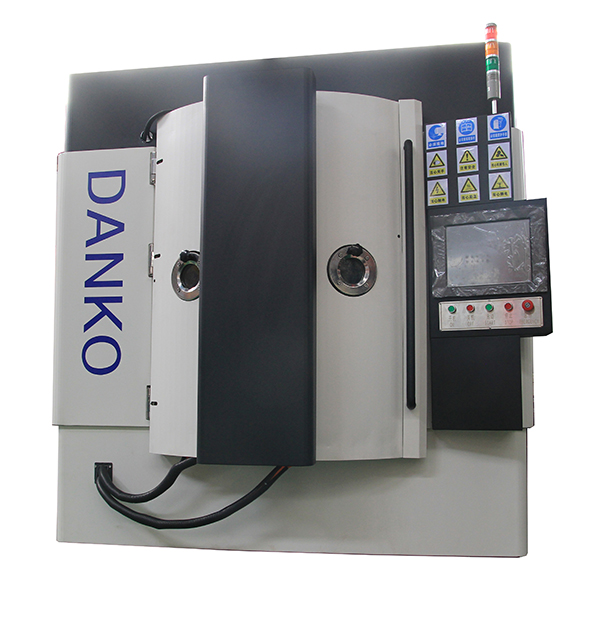 Hardware Decoration PVD Vacuum Coating SystemReview this multi-arc PVD system for door handles, sanitary fittings, and mixed metal components, with dense, adherent decorative films and adjustable colors.View Product →
If your range includes decorative hardware, sanitary fittings, furniture pulls, or mixed metal components, it is worth reviewing how PVD coating systems are specified before fixing chamber dimensions. The goal is a line that can repeat your best sample, not one that simply meets a headline coating rate.
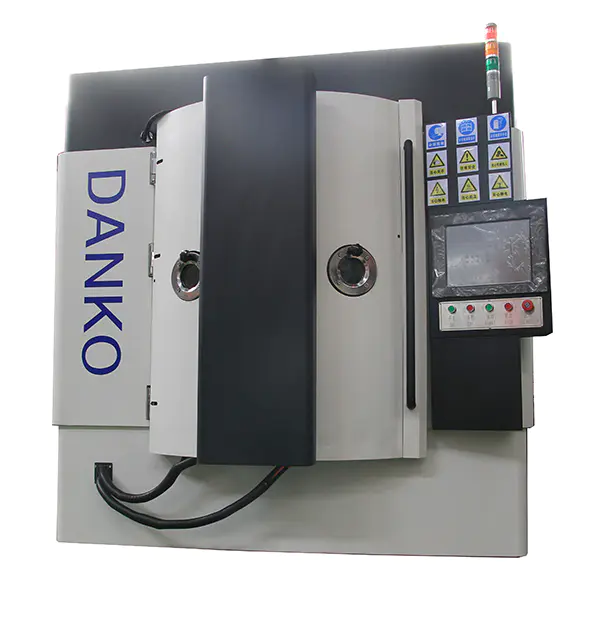 Decorative PVD Vacuum Coating Equipment RangeCompare decorative PVD coating equipment—multi-arc, magnetron sputtering, and evaporation—for hardware, sanitary ware, watches, and ceramic or glass decorative films.View Product →
Most coating defects begin before the door handle reaches the vacuum chamber. Polishing marks, residual oils, dust, fingerprints, and moisture can all disturb film growth. Cleaning discipline is therefore not a supporting detail; it is part of the finish specification. Use the right wash chemistry, rinse quality, drying method, and handling gloves for the substrate. Then confirm that parts are fully dry before loading.
Inside the chamber, vacuum quality, leak rate, target condition, gas flow, arc or sputter power, bias, and deposition time all need to sit inside a repeatable window. A recipe that only works on one rack position is not a production recipe. Color and thickness should be checked across the load, including the faces that are hardest to see and the edges that receive the most handling.
Validation should match the way the handle is used. Cross-hatch adhesion, abrasion testing, humidity or salt-spray exposure, perspiration resistance, and color or gloss verification are common checkpoints. The exact mix depends on the market and the claim being made, so agree on the test plan before the first production batch.
A door handle is a small object with a large job. It has to feel good in the hand, match the architecture around it, and survive repetitive contact without losing its composure. A door handle PVD coating machine contributes to that result, but it does not create it alone. The finish begins with substrate choice, polishing, cleaning, rack design, recipe discipline, and a validation plan that reflects real use.
For manufacturers building or expanding a decorative hardware line, the practical path is to test the actual handle family, not a generic coupon. Review the full process with our vacuum coating systems and with the people who will run the line every day. When the chamber, the rack, and the quality routine are designed together, PVD becomes more than a surface treatment. It becomes a quiet, repeatable signature on a product people touch without thinking.
Your email address will not be published. Required fields are marked *

 Tel: +86-13486478562
 FAX: +86-574-62496601
 Email: [email protected]
 Address: No. 79 West Jinniu Road, Yuyao, Ningbo City, Zhejiang Provice, China
 OEM/ODM PVD Coater Manufacturers