Product Consultation
Your email address will not be published. Required fields are marked *

When evaluating an automotive coating machine, overspray recovery rate is one of the most critical performance indicators — directly affecting material costs, environmental compliance, and surface finish quality. In direct comparison, electrostatic coating machines achieve transfer efficiency rates of 85–95%, significantly outperforming conventional air-spray automotive coating machines, which typically range between 30–60%. However, the full picture is more nuanced: the best system depends on part geometry, coating material, production volume, and integration requirements.
This article breaks down the key differences in overspray recovery, explains why transfer efficiency varies across systems, and helps you determine which technology best suits your automotive finishing operation.
Overspray recovery rate — also called transfer efficiency (TE) — measures the percentage of coating material that actually adheres to the target substrate versus the amount lost as overspray into the surrounding environment. A higher TE means less wasted coating, lower VOC emissions, reduced booth contamination, and lower material costs per unit.
In automotive manufacturing, where coating materials such as primers, basecoats, and clearcoats can cost thousands of euros per drum, even a 10% improvement in transfer efficiency translates into substantial annual savings. For a line producing 500 vehicles per day, the difference between 50% and 90% TE can represent hundreds of thousands of euros in recovered material annually.
A standard automotive coating machine using air-assisted or airless spray technology operates by atomizing liquid coating through high-pressure nozzles. While effective for applying high-viscosity coatings across complex geometries, these systems suffer from significant overspray losses.
These figures reflect real-world performance on automotive body panels. Losses are caused by turbulent airflow in the spray booth, rebound from curved or recessed surfaces, and the physical limitations of non-directional atomization. Booth filtration and recirculation systems can capture some overspray, but recovered material is rarely reusable in quality-critical automotive applications.
Electrostatic coating machines apply a high-voltage electric charge (typically –30 kV to –100 kV) to atomized coating particles. The grounded workpiece attracts the charged particles, creating a "wrap-around" effect that pulls coating onto surfaces that a conventional spray gun would miss entirely — including edges, recesses, and the reverse sides of parts.
This electrostatic attraction dramatically reduces the amount of coating that drifts past the target, resulting in:
Rotary bell atomizers are now the dominant technology in OEM automotive topcoat lines precisely because of this efficiency advantage. A single bell atomizer can coat an entire car body with 30–40% less material than an equivalent HVLP spray system.
| Parameter | Conventional Automotive Coating Machine | Electrostatic Coating Machine |
|---|---|---|
| Transfer Efficiency | 30–75% | 65–98% |
| Wrap-Around Effect | None | Strong |
| Suitable for Complex Geometry | Moderate | Excellent |
| Coating Material Compatibility | Very broad | Requires conductive or adapted materials |
| VOC Emissions | Higher | Lower |
| Equipment Cost | Lower | Higher |
| Operating Cost (per unit) | Higher (more material waste) | Lower (less material waste) |
| Best Application | Flexible production, small batches | High-volume OEM lines |
Despite their superior overspray recovery, electrostatic coating machines are not universally superior. There are specific scenarios where a conventional automotive coating machine remains the more practical choice.
Deep recesses, cavities, and internal channels on automotive components create what is known as the Faraday cage effect — areas where the electric field is too weak to attract charged particles. In such zones, electrostatic machines can actually deliver worse coverage than conventional systems, requiring supplementary spray steps that reduce the overall efficiency advantage.
Electrostatic systems require the coating material to have specific resistivity characteristics — typically between 0.5 and 50 MΩ·cm. Many high-solid or metallic-effect coatings used in automotive finishing require formulation adjustments to be compatible, which can increase material costs and limit supplier options.
Non-conductive substrates such as plastic bumpers, mirror housings, and interior trim pieces cannot be electrostatically coated without pre-treatment (e.g., conductive primers or flame treatment). A conventional automotive coating machine handles these substrates without any pre-conditioning requirement.
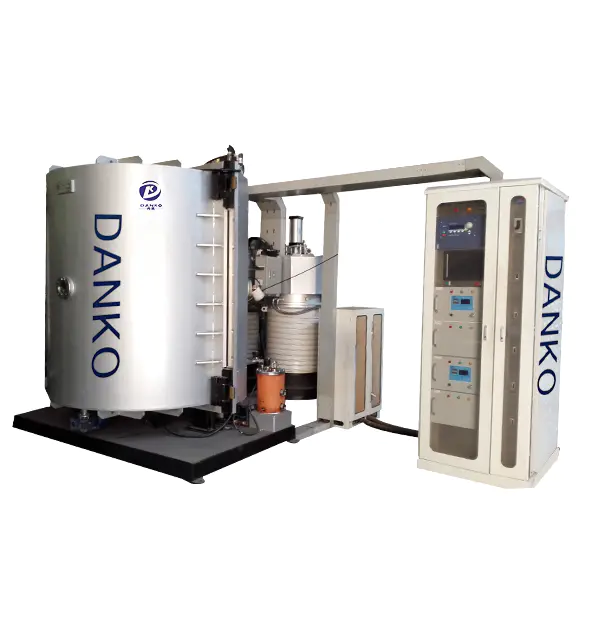
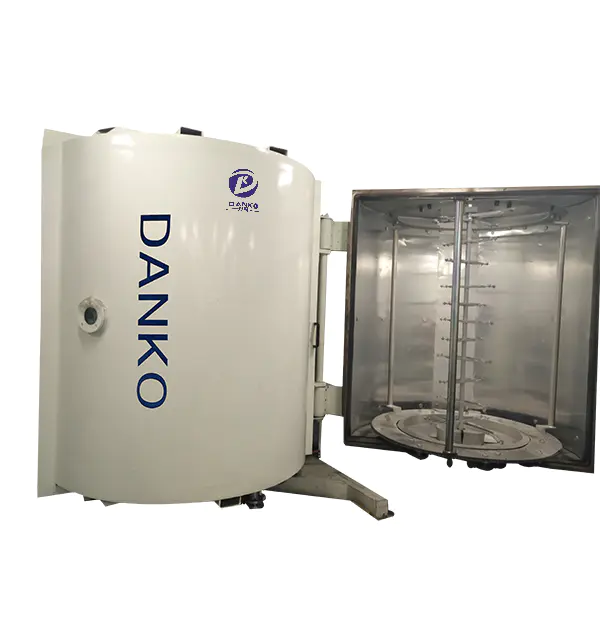
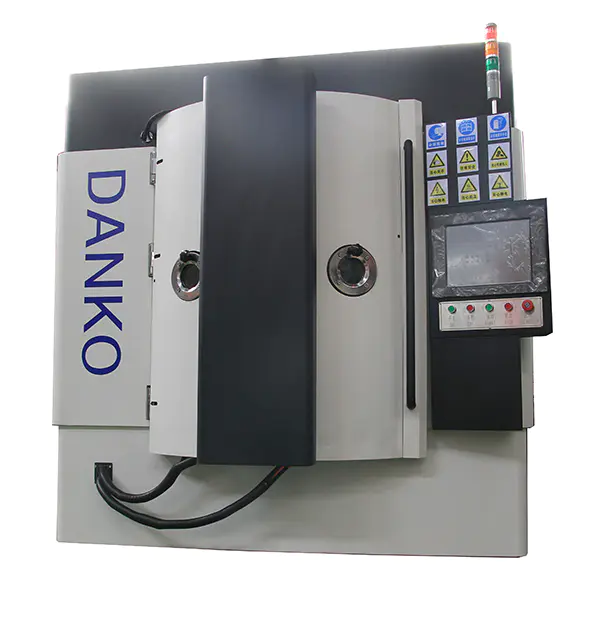
Beyond liquid coating systems, the automotive industry increasingly relies on advanced thin-film deposition technologies for functional and decorative surface finishes. A PVD coating machine (Physical Vapor Deposition) operates under vacuum conditions to deposit ultra-thin metallic or ceramic layers — commonly used for automotive trim, wheel accents, and interior hardware. PVD processes achieve near-100% material utilization within the deposition chamber because the process occurs in a sealed vacuum environment, making overspray essentially non-existent.
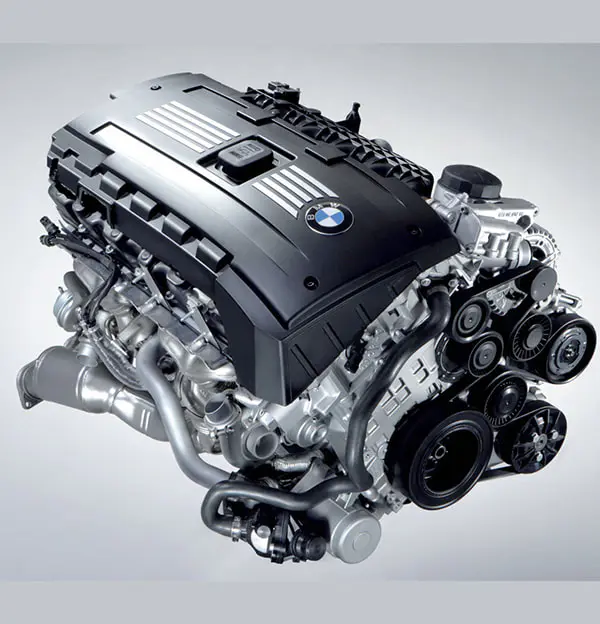
Similarly, a DLC coating machine (Diamond-Like Carbon) applies extremely hard, low-friction carbon-based coatings onto engine components, pistons, and transmission parts. DLC systems also operate in vacuum or low-pressure plasma environments, resulting in highly controlled deposition with minimal material waste. While PVD and DLC coating machines are not direct substitutes for liquid automotive coating machines in bodywork applications, they represent the high-efficiency end of the automotive surface treatment spectrum — where material recovery is optimized by process design rather than spray management.
To quantify the financial benefit of switching from a conventional automotive coating machine to an electrostatic system, use the following formula:
For a production facility coating 200,000 vehicle bodies per year, applying 400g of clearcoat per body at €8/kg, moving from 55% to 90% TE reduces material consumption by approximately 28%, saving over €200,000 annually in clearcoat alone — before accounting for reduced booth maintenance, lower VOC treatment costs, and fewer waste disposal fees.
The right automotive coating machine for your operation depends on several factors. Use the guidance below to identify the best fit:
In most high-volume automotive finishing environments, electrostatic coating machines deliver a clear and measurable advantage in overspray recovery. However, no single technology covers every application. A well-designed automotive coating operation often combines multiple system types — using each where its strengths are greatest — to optimize both finish quality and material efficiency across the full production line.
Your email address will not be published. Required fields are marked *
Tel: +86-13486478562
FAX: +86-574-62496601
Email: [email protected]
Address: No. 79 West Jinniu Road, Yuyao, Ningbo City, Zhejiang Provice, China

OEM/ODM PVD Coater Manufacturers