
 Email:
 Tel:+86-13486478562

 Language
 Español
 Português





Specification
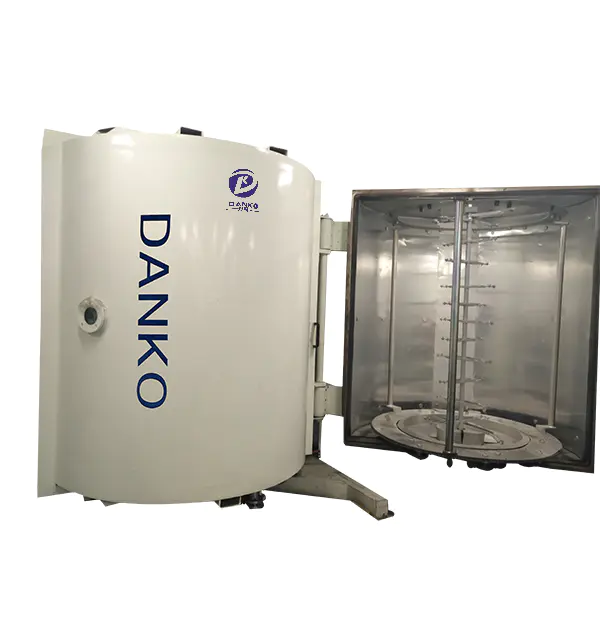
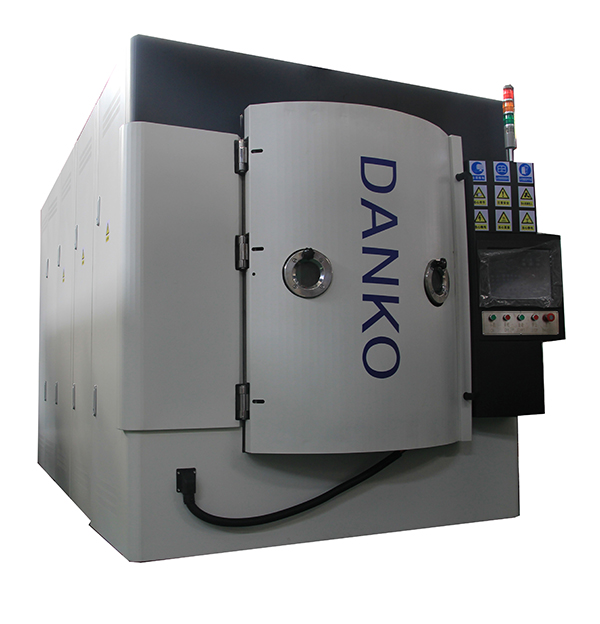
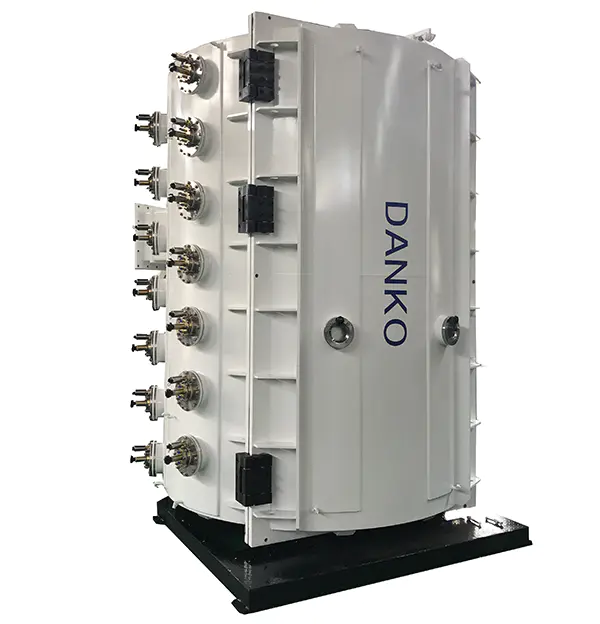
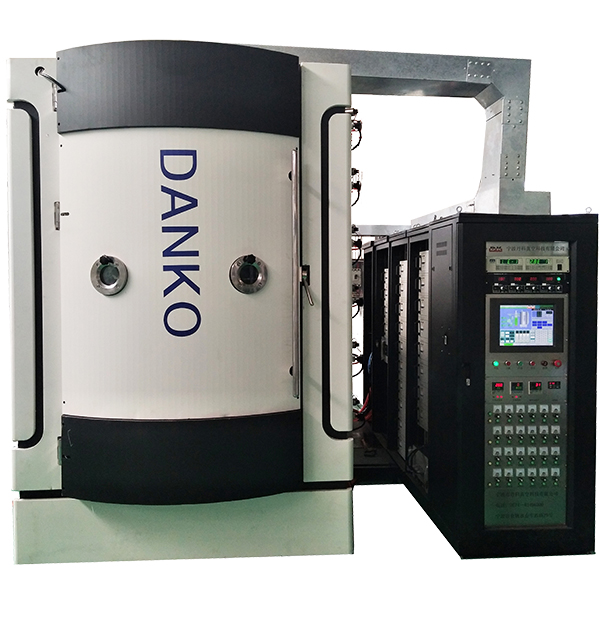
Direct metallization equipment is configured around the substrate polymer's outgassing rate, surface-energy activation threshold and required corrosion or abrasion resistance. The table below lists our standard Yuyao production builds.
| Item | Typical Configuration | Notes |
|---|---|---|
| Process Architecture | In-situ 3-stage dry cycle: Plasma Activation → PVD Metallizing → PECVD Topcoat | Eliminates wet UV basecoat spray booth and intermediate handling steps. |
| Pre-Treatment Source | 13.56 MHz RF plasma electrode, MF glow bar, or linear anode-layer ion source | Raises polymer surface energy from ~30 mN/m to >68 mN/m for 5B cross-hatch adhesion. |
| Metallizing Source | DC/MF planar or rotary magnetron cathodes, or BN/TiB₂ boat thermal evaporation | Sputtering gives higher adatom energy for direct bonding; boat evap maximizes speed. |
| Metal Options | High-purity Al, Cr, 316L stainless steel, Ti, Zr, In, Sn and Cu alloys | Supports specular reflector Al, automotive exterior Cr, and NCVM indium/tin stacks. |
| In-Situ Topcoat | Closed-loop HMDSO / HMDSN monomer vapour dosing + plasma polymerization | Deposits a 30–80 nm hydrophobic SiOₓCᵧH₂ barrier passing 240–480 h salt spray. |
| Chamber Design | Horizontal front-loading vessel (Ø1,100–2,000 mm) or vertical twin-door batch | Electropolished 304 stainless steel interior with full water jacket and quick-change liners. |
| Pumping Group | Dry screw or rotary-vane roughing pump + Roots booster + turbomolecular/diffusion pump | Oil-free dry roughing + turbo option prevents hydrocarbon backstreaming onto bare resin. |
| Water-Vapour Trap | Cryogenic Meissner trap (-120 °C) mounted inside the main pumping manifold | Captures moisture outgassing from bare BMC, PC, PA and ABS mouldings. |
| Base & Process Vacuum | Base 2 x 10⁻³ Pa; plasma activation at 1–5 Pa; deposition at 2 x 10⁻² to 3 x 10⁻¹ Pa | Automated throttle valve transitions smoothly between plasma, metal and HMDSO steps. |
| Planetary Fixtures | Dual wheeled trolleys with 6 to 10 planetary spindles (revolution + self-rotation) | Racks can be loaded directly at the injection-moulding press to avoid dust pick-up. |
| Thermal Control | Unheated chamber operation keeping substrate temperature below 55–65 °C | Prevents warpage or sink-mark telegraphing on thin-wall PC, ABS and PP mouldings. |
| Film Thickness | 40–120 nm metal layer + 30–80 nm plasma-polymerized protective overcoat | Controlled via power-time integral, quartz crystal monitor or optical endpoint. |
| Cycle Time | 12 to 25 minutes per full dry cycle (activation + metal + HMDSO topcoat) | Replaces 60+ minutes of multi-stage wet spraying, flash-off and UV curing. |
| PLC & HMI | Industrial PLC + 15-inch touchscreen with multi-stage recipe lock and data logging | Records plasma power, monomer flow, pressure curves and batch ID for Tier-1 traceability. |
| Utilities | 3-phase 380 V 50 Hz (adaptable), chilled water 18–22 °C, oil-free compressed air | Includes monomer cabinet exhaust interlocks and CE-compliant safety guarding. |
| Warranty & Spares | 12-month free warranty on complete equipment; long-term discounted consumables | Includes baseline recipes, onsite commissioning and operator maintenance training. |
Send us your bare moulded parts, resin datasheet and OEM adhesion/humidity test specification. Our Yuyao process lab will run direct-metallizing trials and confirm the exact plasma and source configuration before quoting.
Application
Direct metallization is adopted wherever liquid basecoats either add unacceptable VOC/floor-space cost or blur fine moulded surface detail. Across our customer installations, these primer-free systems serve the applications below.
-
Automotive headlamp and fog-lamp reflectors. Moulded BMC, PEI, PPS and high-heat PC reflectors receive direct aluminium metallizing plus an in-situ HMDSO topcoat, preserving sharp optical facet geometry and passing thermal-shock and humidity cycling without primer bubbling.
-
Automotive exterior chrome trim and radar emblems. Front-grille louvers, window surrounds and millimeter-wave radar badges in ABS or PC/ABS gain direct sputtered chromium or NCVM indium/tin stacks without wet basecoat orange-peel defects.
-
Cosmetic closures and mono-material packaging. PP and PETG caps, jars and dispenser collars achieve a bright metallic finish without UV paint layers—keeping the package mono-material and 100% recyclable under European packaging rules.
-
Sanitary showerheads and plumbing escutcheons. Injection-moulded ABS shower faces and tap covers receive direct plasma activation followed by sputtered stainless steel, chrome or PVD gold/black finishes resistant to hot-water condensation.
-
Appliance control knobs and interior bezels. Refrigerator handles, washing-machine dials and coffee-maker trims move straight from injection moulding to the PVD chamber, avoiding paint-line dust rejects on glossy black or clear PC resins.
-
Medical device housings and diagnostic reflectors. Optical cuvettes, surgical lamp reflectors and handheld scanner shells gain sterile, outgas-free metallic coatings without solvent primer residues.
-
Die-cast zinc and aluminium hardware. Polished Zamak handles and alloy housings undergo argon ion etching and direct PVD coating without intermediate electroless nickel or copper-nickel electroplating.
Success in primer-free metallizing starts at the injection-moulding press. Because there is no liquid basecoat to hide flow lines or sink marks, the mould cavity must be polished to optical (SPI A1/A2) or controlled satin finish, and mould-release sprays containing silicone must be avoided. When parts are racked straight at the press onto clean PVD spindles, defect rates routinely drop below 1%–2%, compared with 8%–15% on traditional wet-spray lines.
For polyolefins such as polypropylene (PP) and thermoplastic elastomers that naturally resist bonding, Danko combines oxygen/argon RF plasma activation with a thin titanium or chromium adhesion tie-layer before depositing the final reflective metal and HMDSO protective barrier.
If you want to benchmark direct metallizing against your current wet-lacquer line, ship 20 to 30 unprimed mouldings to our Yuyao facility—we will coat them and return full cross-hatch tape, boiling-water and humidity test reports.
Advantage
Cutting out the wet basecoat transforms both plant economics and part quality. Manufacturers choose Danko direct metallization systems for several measurable shop-floor advantages.
-
Eliminates wet basecoat booths and VOCs. Removing primer spray guns, flash-off tunnels and UV curing ovens cuts factory footprint by up to 40%, slashes paint material spend and removes VOC abatement headaches.
-
Preserves micro-optical and textured precision. With total film thickness under 200 nm, sharp reflector facets, brushed hairlines and fine laser-etched logos remain razor-sharp instead of rounding off under a 15 µm liquid primer.
-
Higher first-pass yield without paint-nib rejects. Parts never travel through open spray booths before metallizing, eliminating airborne lint, solvent popping and primer runs that account for most scrap in conventional lines.
-
All-in-one single-pump-down architecture. Plasma activation, metal sputtering/evaporation and HMDSO plasma topcoating run sequentially inside one recipe, cutting WIP inventory and labour handling between departments.
-
Supports mono-material circular packaging. Without crosslinked acrylic/urethane lacquer layers, metallized PP, PE and PET packaging components stay compatible with standard single-stream polymer recycling.
-
Engineered in-house by Ningbo Danko. Our 90-person team builds the RF/ion plasma sources, sputtering/evaporation cathodes, HMDSO dosing manifolds and PLC logic under one roof for tight process synchronization.
-
12-month warranty & discounted consumables. Every machine ships with a 12-month free complete equipment warranty, onsite commissioning, operator training and long-term discounted targets, boats and monomers.
Operating cost per square metre drops sharply once liquid primer, thinner, spray-booth filters and UV lamp replacements are removed from the bill of materials—typically amortizing the incremental plasma and sputtering hardware within 10 to 16 months.
To protect optical cleanliness over thousands of cycles, our chambers incorporate removable stainless steel liners, heated monomer lines that prevent HMDSO condensation, and automated plasma self-clean routines.
When evaluating direct metallization suppliers, check plasma uniformity across the full spindle height and verify whether the pumping train is oil-free—even trace mechanical-pump oil vapour can ruin direct metal-to-plastic adhesion.


 Tel: +86-13486478562
 FAX: +86-574-62496601
 Email:
 Address: No. 79 West Jinniu Road, Yuyao, Ningbo City, Zhejiang Provice, China
