 Email:
  Tel:+86-13486478562
 Language
  Español
 Português
Product Consultation
Your email address will not be published. Required fields are marked *
Manufacturers of door handles face a common dilemma. A zinc alloy handle that looks perfect in a showroom can develop visible wear after a few months of daily use. A stainless steel handle may resist corrosion but miss the requested gold or black finish. A door handle plasma coating machine solves both problems by depositing a thin, hard PVD film that combines decorative color with strong adhesion and wear resistance.
The machine works in a vacuum chamber where an inert gas is turned into plasma, and material from a solid target is transferred onto the handle surface. This is not a liquid paint spray, and it is not an atmospheric plasma treatment that only changes surface energy. It is a physical vapor deposition process that builds up a dense metallic or carbon-based layer, typically between 0.5 and 2 μm thick.
Because the coating is formed atom by atom, it follows the curved contours of a door handle more uniformly than most wet finishing methods. The film will not drip, sag, or leave a thick edge. In the door handle industry, "plasma coating" usually means plasma-assisted PVD inside a vacuum chamber, not thermal plasma spraying of thick ceramic layers.
Confusion sometimes arises because plasma coating can refer to several different technologies. In the context of door handles, the machine uses the plasma as a carrier of energy and ions. Two mainstream methods are used: cathodic arc evaporation and magnetron sputtering. Both are forms of PVD, and both create a plasma inside the chamber to supply the ions needed for coating deposition.
In a cathodic arc system, an electric arc burns on the surface of a metal target, releasing atoms and ions that condense on the parts. The process has a high deposition rate and creates very hard films, but it can produce microscopic droplets that affect surface smoothness unless filters are used. In magnetron sputtering, a magnetic field confines electrons above a target, and accelerated ions knock atoms off the target one by one. This gives a smoother coating and precise color match, with a slightly lower rate.
Suppliers usually choose a process based on the finish required. For door handles, arc evaporation is common for hard, dark, or colored coatings. Sputtering is common for light silver and champagne tones where smoothness matters.
Typical coatings include:
These coatings are dense enough to protect the base metal from oxidation and mild abrasion, while the layer remains thin enough not to alter the dimensions of a precision hinge or locking mechanism.
The choice between arc and sputtering has a direct effect on production cost and final appearance. The table below summarizes the practical differences for a typical door handle application.
| Process | Surface finish | Deposition speed | Color stability | Typical door handle material |
|---|---|---|---|---|
| Cathodic arc | Fine and hard; can show tiny droplets without filtering | High | Very stable for dark and saturated colors | Zinc alloy, brass, steel |
| Magnetron sputtering | Smooth and dense | Moderate | Excellent for silver and light tones | Aluminum, stainless steel, high-end designs |
Your choice should follow the color and smoothness you need to sell. If the order is for brushed champagne or deep black handles, arc deposition is often the faster route. If the job is for polished steel-look handles, sputtering gives the clean reflective surface that customers expect.
Before requesting quotes, define your daily output and your part mix. A chamber with a larger working area can handle more handles per batch, but the cycle time is set by the coating recipe. The substrate temperature, the thickness target, and the number of rotation axes inside the chamber all affect the total cycle.
Ask the supplier to calculate the number of workpieces per rack and the maximum rotating diameter. For a typical arched lever handle, you need the parts to rotate in three dimensions so the plasma reaches the inner face of the grip and the surface behind the rose. A flat, fixed orientation will leave thin deposits on recessed areas.
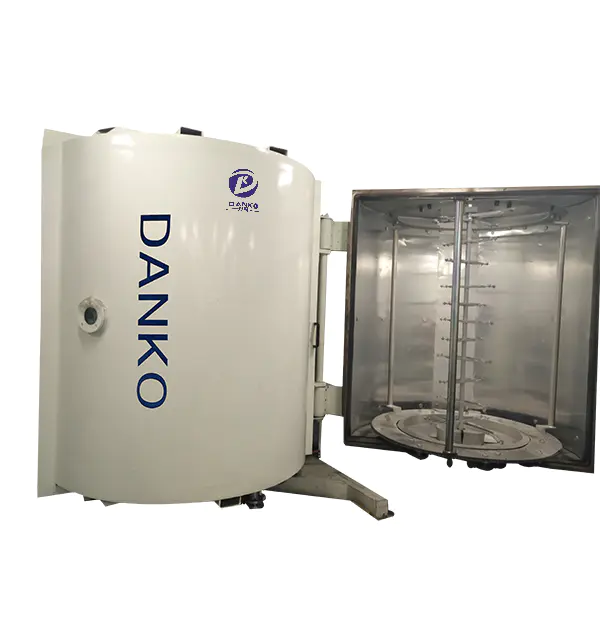
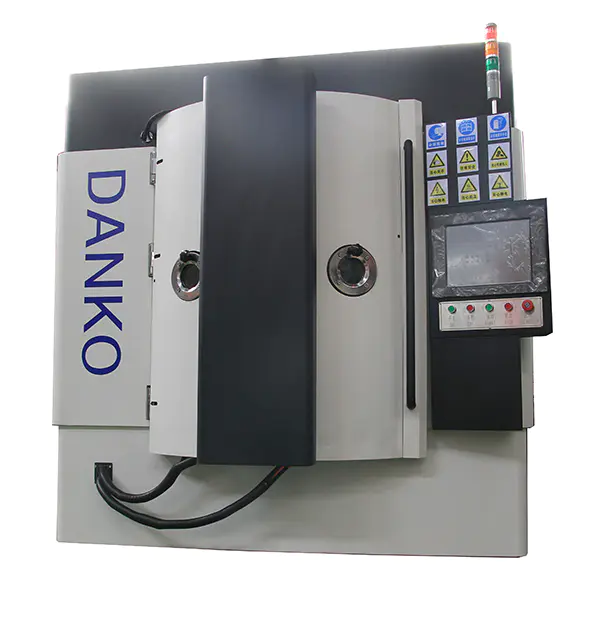
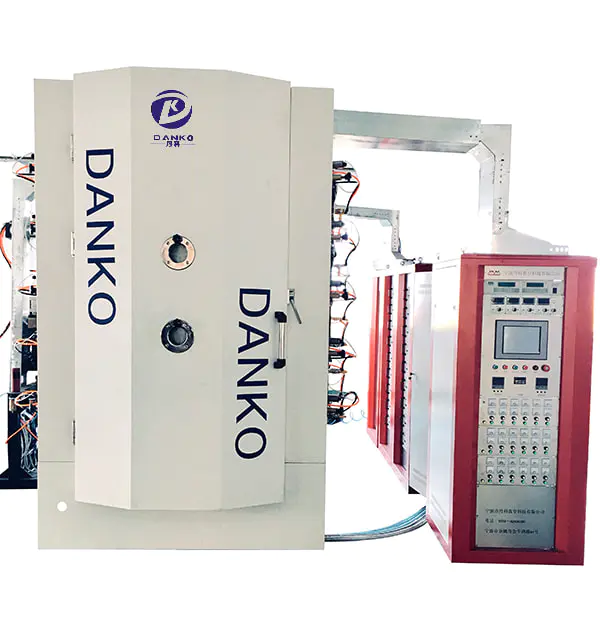
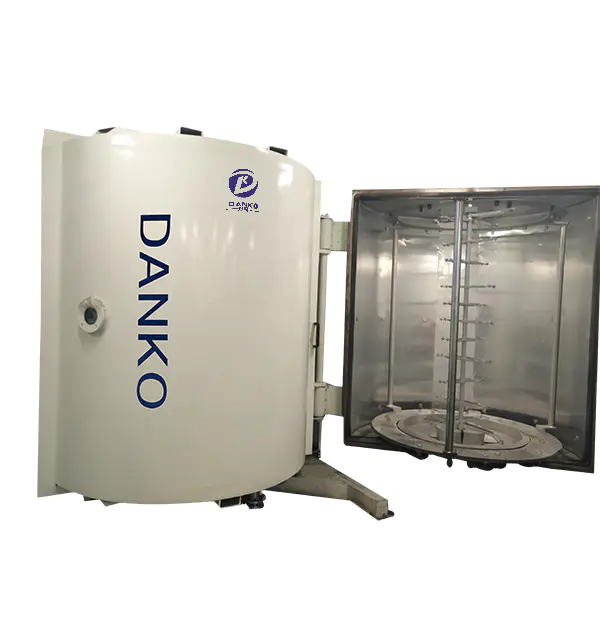
One practical approach is to select a system that has already been configured for door hardware production. Many manufacturers install a hardware decoration PVD vacuum coating machine for knobs, pulls, and handle sets because the chamber layout, fixture design, and control program have been proven on similar parts.
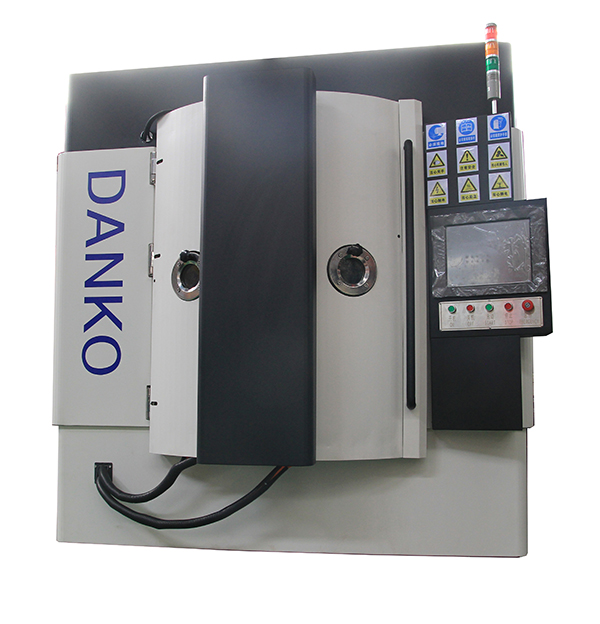 Custom Hardware decoration PVD vacuum coating machine Suppliers, Factory - NingbNingbo Danko Vacuum Technology Co., Ltd. is China custom Hardware decoration PVD vacuum coating machine suppliers and factory,Hardware De...View Product →
Also check the color repeatability from batch to batch. The machine must be able to reproduce the same LAB color value over weeks of production. This depends on target materials, gas flow stability, and bias voltage control. You do not need to understand every control parameter, but you should ask to see the color measurement results from repeated test runs.
Door handles for cars are a higher-stakes version of the same problem. The coating must match the body trim, survive UV exposure, resist salt spray, and tolerate repeated pulling with wet or gloved hands. An ordinary decorative coating may pass a visual check but fail after a few months in a hot climate.
For automotive door handles, the fixture design is more critical because the parts are long and curved. The coating must have uniform color along the entire front surface, and the back side does not always need the same gloss. A dedicated automotive line can manage these requirements with rotational motion and adjustable layer thickness.
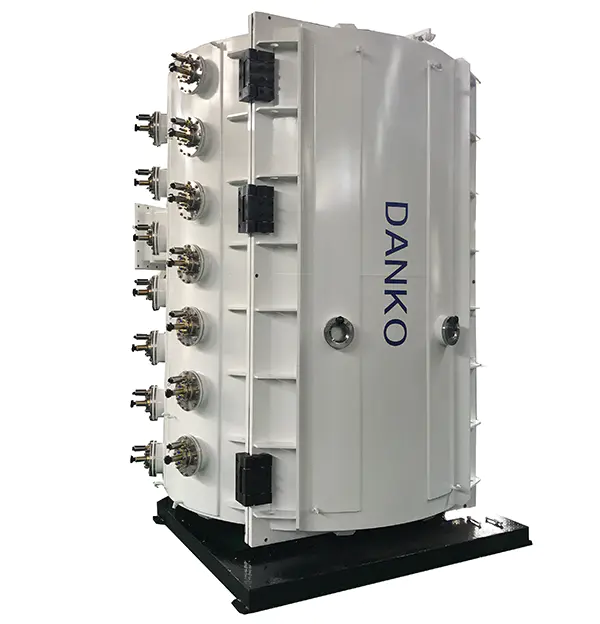
An automotive decorative parts coating machine is usually supplied with a recipe set for common automotive finishes such as silver, gunmetal, or black chrome. If your target is a specific brand shade, ask the supplier to match it on a sample handle before the production order.
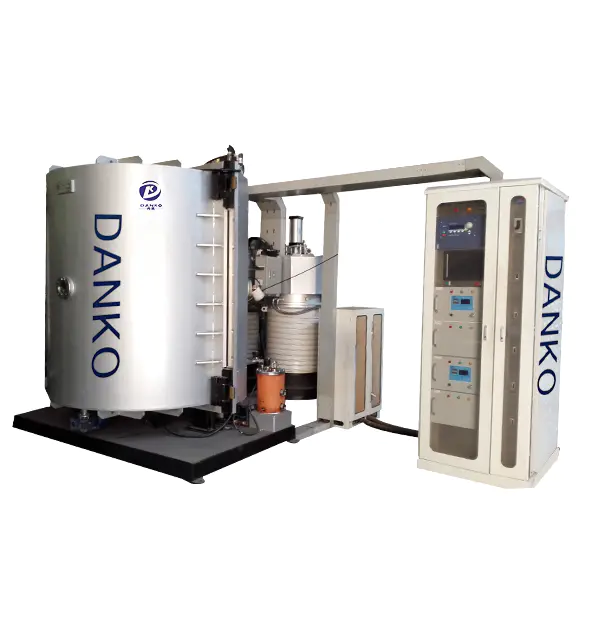 Custom Special coating machine for automotive decorative parts Suppliers, FactorNingbo Danko Vacuum Technology Co., Ltd. is China custom Special coating machine for automotive decorative parts suppliers and factory,View Product →
Do not rely on a data sheet alone. Send actual door handle samples to the manufacturer and ask for a trial coating on your substrate. If the substrate is zinc alloy, make sure the pre-treatment removes any die-casting release agent and oxide layer. If the substrate of the handle is stainless steel, the surface prep is different.
What you should expect in a test report:
Interpret the numbers with the intended application in mind. A door handle used on a commercial building will need higher abrasion resistance than a decorative handle used on a light-usage cabinet. An exterior door handle will need better salt spray performance than an interior bathroom handle.
Cleaning is part of the machine purchase even if it is not part of the coating chamber. Most adhesion failures start at the cleaning stage. A simple three-step line with degreasing, hot rinse, and tunnel dryer is enough for many door handles. Some manufacturers also use a glow-discharge cleaning step inside the vacuum chamber to remove the last monolayer of contamination.
The initial price of a door handle plasma coating machine is only one line in the total cost. Operating costs include electric power, process gases, target consumption, pump maintenance, and periodic cleaning of chamber walls. For example, a cathodic arc system may use more electricity than a sputtering system but often deposits faster.
Replacement parts such as vacuum pump oil and targets should be available from the same supplier. If you order a complete line, the after-sales support is easier to manage. Have the supplier specify a recommended spare parts list for the first 12 months.
Finally, calculate the actual cost per handle. Include coating consumables and labor. This is the number that tells you whether plasma coating is more economical than your current electroplating or paint operation.
A door handle plasma coating machine is not a single-purpose gadget. It is a production tool that can change the quality and cost structure of a finishing line. The practical way to start is simple: choose a machine size that matches your daily volume, define the color and durability target, and run a trial on your own parts. If the supplier can show you repeatable color, good adhesion, and a realistic cycle time, the machine will pay for itself through fewer rejects and longer-lived handles.
Your email address will not be published. Required fields are marked *

 Tel: +86-13486478562
 FAX: +86-574-62496601
 Email: [email protected]
 Address: No. 79 West Jinniu Road, Yuyao, Ningbo City, Zhejiang Provice, China
 OEM/ODM PVD Coater Manufacturers