 Email:
  Tel:+86-13486478562
 Language
  Español
 Português
Product Consultation
Your email address will not be published. Required fields are marked *
The gold on a door handle, the gunmetal on a shower column and the rose gold on a hinge rarely come out of a plating bath anymore — they come out of a vacuum chamber. This guide explains how a hardware PVD coating machine builds those finishes, and which route suits which product.
Walk through a hardware plant that has upgraded its surface treatment and the pattern repeats across the industry: wet electroplating lines are being replaced or supplemented by physical vapor deposition. The reasons are practical. A PVD film grows from metal vapor in a near-total vacuum, so there is no acid bath to treat and no chromium-bearing wastewater, while the film itself is harder — titanium nitride reaches roughly 2,300 HV against about 800 HV for hard chrome — and holds its color under abrasion far longer.
The short version for anyone specifying equipment: multi-arc ion deposition is the workhorse for decorative hardware in gold, champagne and bronze tones; magnetron sputtering wins where smooth, uniform black, grey or chrome-look films matter; hybrid chambers cover premium mixed batches. Everything else — jigging, cycle time, cleaning discipline, consumables — decides whether that answer survives contact with your real parts.
All hardware PVD coaters share one skeleton. The chamber is pumped to a high-vacuum baseline, argon is admitted and ionized, and the coating material enters that plasma — vaporized by a cathodic arc, knocked from a target by sputtering, or evaporated from a filament. A bias voltage drives metal ions into the parts, where they condense into a dense film typically 0.3 to 1.5 micrometers thick. Reactive gases steer the chemistry: nitrogen over titanium gives golden TiN, acetylene pushes toward black carbides, and oxygen serves oxide tints and anti-fingerprint layers.
Before any of that, a short ion-etching stage bombards each part with energetic particles to strip the last molecular layer of contamination and activate the surface. It looks like a pause in the cycle; it is the step that makes the film stick.
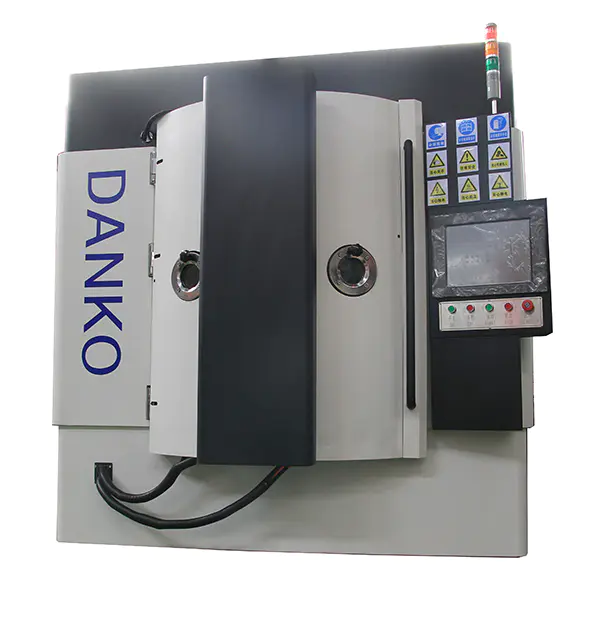
For mixed decorative batches — handles, hinges, locks, nameplates, watch-band style trims — purpose-built machines package arc sources, rotating racks and a bias supply around exactly this workflow. A representative configuration of that class is the machine below.
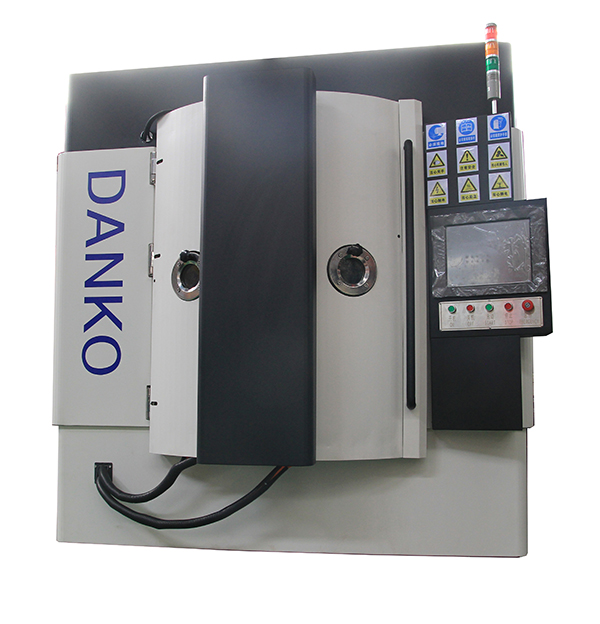 Hardware Decoration PVD Vacuum Coating MachineA purpose-built arc PVD machine combining arc sources, rotating racks and bias supply for mixed decorative batches such as handles, hinges, locks and nameplates, where high ionization films give strong adhesion on brass and zinc alloy.View Product →
Arc spots racing across a titanium, zirconium or chromium target vaporize material with a high ionization fraction, commonly quoted at 60–90 percent. That ion flux is why arc films grip brass, stainless steel and zinc alloy so firmly, and why two or three batches per shift are realistic. The trade-off is micro-droplets: tiny nodules thrown from the arc spot can mark mirror-polished faces, so visible surfaces may need tuned parameters or a smoothing sputtered layer on top.
Sputtering ejects target atoms with argon ions at lower temperature and without droplets. Films come out smoother, denser and easier to hold inside a tight color window — which is why premium black, gunmetal and chrome-look hardware, and most anti-fingerprint topcoats, are sputtered. The price is a slower deposition rate and closer control of target poisoning when reactive gases run.
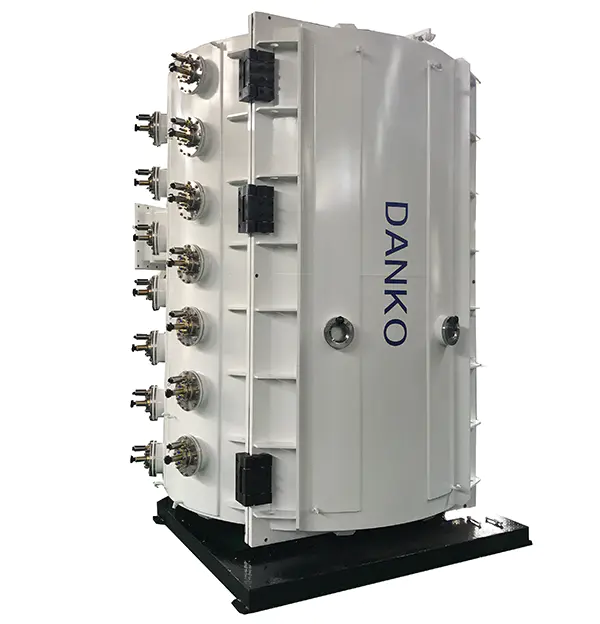
For the deep-black finish so widely specified on tapware and trim programs, a dedicated sputtering line is the usual answer:
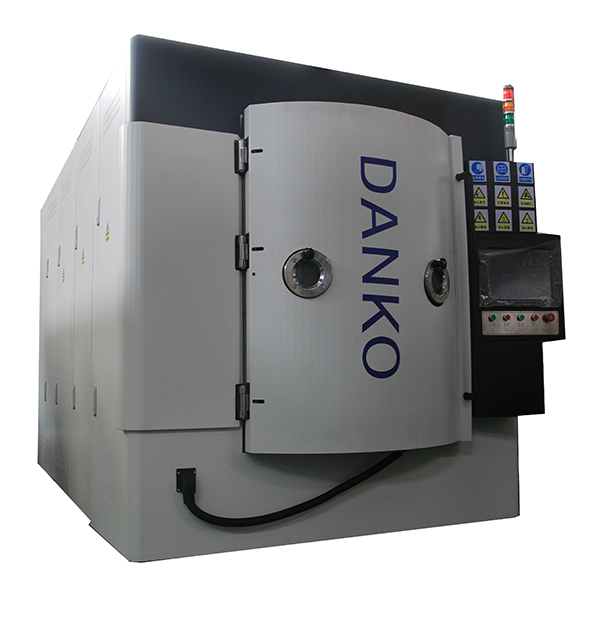 Dark Black PVD Coating MachineA dedicated sputtering line for deep-black finishes on tapware and trim programs, using magnetic-field-guided deposition and substrate rotation to achieve uniform, consistent black coatings on visible surfaces.View Product →
Evaporation remains the economical route for aluminum metallizing on plastic trims, cosmetic caps and reflector housings, where a lacquer protects the soft metal film instead of the film carrying wear on its own.
| Process route | Best suited for | Strengths | Points to watch |
|---|---|---|---|
| Multi-arc ion | Gold, champagne and bronze tones on handles, locks, hinges | High ionization, strong adhesion, fast cycles | Micro-droplets on mirror faces |
| Magnetron sputtering | Black, gunmetal, chrome-look and anti-fingerprint finishes | Smooth, dense films with tight color control | Slower rate; target cost and poisoning |
| Thermal evaporation | Aluminum metallizing on plastics, caps, reflectors | Low cost, high throughput | Soft film; needs a protective topcoat |
| Hybrid arc + sputtering | Premium mixed-batch hardware lines | Combines arc speed with sputtered smoothness | Higher investment and process know-how |
Color in PVD is chemistry rather than dye. Titanium run in nitrogen lands in the gold range; zirconium nitride shifts toward champagne; adjusting gas flow and bias walks the hue from pale gold through rose gold to bronze. Chromium with acetylene gives blacks and dark greys, while oxygen-doped oxide films produce blues and subtle iridescence. Because the color is the compound itself, it cannot bleed, flake or tarnish the way tinted lacquer over electroplate eventually does.
Anti-fingerprint performance deserves its own line in the specification. Hardware is touched constantly, and skin oils change the look of a bright film long before wear does. Sputtered AF layers — often paired with a hydrophobic topcoat — keep handles and spouts looking clean between washes, an addition retail buyers increasingly request by name.
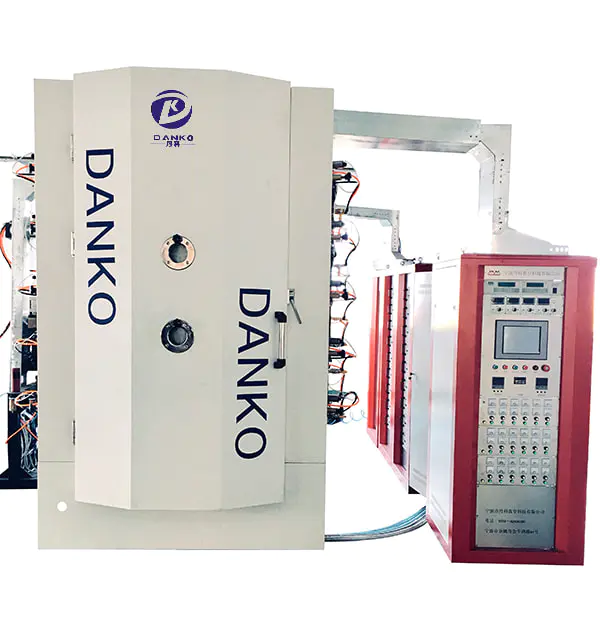
Faucets, shower columns and floor drains concentrate all of these demands at once: constant wetting, detergent attack, fully visible surfaces and heavy daily handling. They are usually coated on a dedicated line of their own.
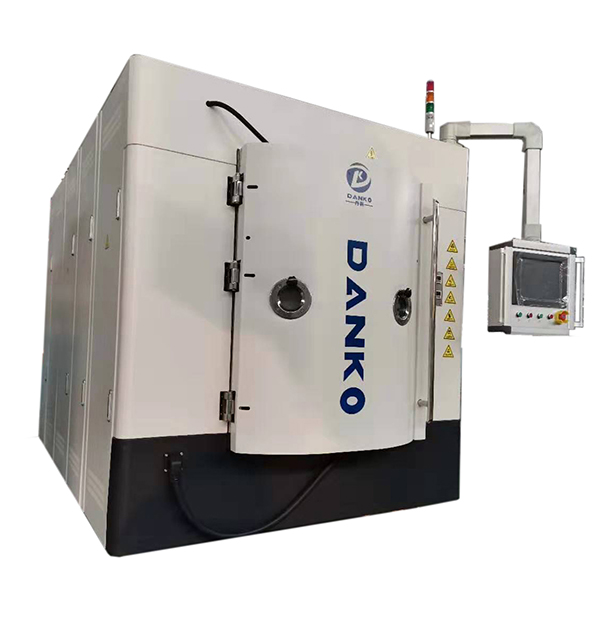 Sanitary Wares Decoration PVD Vacuum Coating SystemA dedicated PVD line for faucets, shower columns and floor drains that face constant wetting, detergent attack and daily handling, with controlled deposition and fixture design to coat fully visible surfaces evenly.View Product →
Color sells the handle in the showroom. Adhesion and fingerprint behavior keep it looking sold six months later — judge a coating quotation on test reports, not on a color fan.
Decorative hardware is a batch business, and the rack matters nearly as much as the power supply. Hinge leaves, screws and badge plates ride on rotating multi-axis jigs so that every face sees the plasma; long items like door handles and shower tubes need spacing calculations to avoid shadowing, the classic cause of thin films on the back face. A well-designed fixture can double effective throughput at zero equipment cost.
Size the chamber to the square meters of coated surface you actually ship each month, not to the largest machine the budget tolerates. A realistic cycle of one to three hours — pump-down, etching, deposition, cooling — sets the tempo for everything upstream in the plant.
The comparison now is less about film quality and more about operating risk. Plating shops face tightening wastewater rules around hexavalent chromium and nickel, rising treatment costs, and batch-to-batch color that depends on the attendant's judgment. A PVD line consumes electricity, argon, nitrogen and targets, produces no process wastewater in normal operation, and reproduces a color recipe by numbers. Complex geometries that trap solution in a plating tank come out evenly coated, because the film grows from vapor rather than from current density.
The wider technical case — adhesion, hardness, heat and corrosion behavior — is laid out in our overview of the advantages of PVD coating over traditional electroplating.
The remaining diligence is unglamorous but decisive:
None of this is exotic. It is simply the difference between a coater that pays for itself within eighteen months and one that becomes the most expensive dust cover in the plant.
A hardware PVD coating machine succeeds or fails as part of a chain: cleaning, jigging, recipe, consumables and the discipline to test on real parts. Aligned, the chamber quietly turns out gold handles and black tapware batch after batch; misaligned, no amount of source power rescues the film. Start with one product family, prove the economics on real parts before scaling, and let the equipment list grow from evidence rather than from catalog enthusiasm.
The machines referenced here — multi-arc decorative lines, sputtering systems, sanitary-ware coaters and the power supplies, pumps and targets behind them — are built by Ningbo Danko Vacuum Technology, which also publishes process notes for hardware manufacturers on an ongoing basis.
Your email address will not be published. Required fields are marked *

 Tel: +86-13486478562
 FAX: +86-574-62496601
 Email: [email protected]
 Address: No. 79 West Jinniu Road, Yuyao, Ningbo City, Zhejiang Provice, China
 OEM/ODM PVD Coater Manufacturers