
 Email:
 Tel:+86-13486478562

 Language
 Español
 Português





Specification
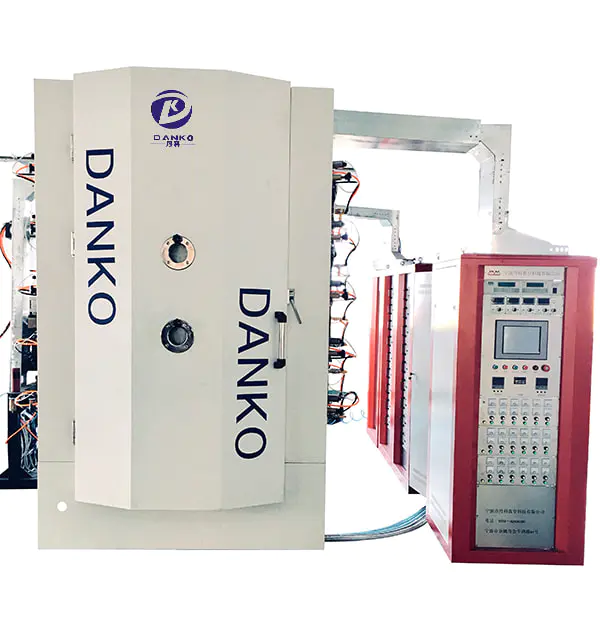
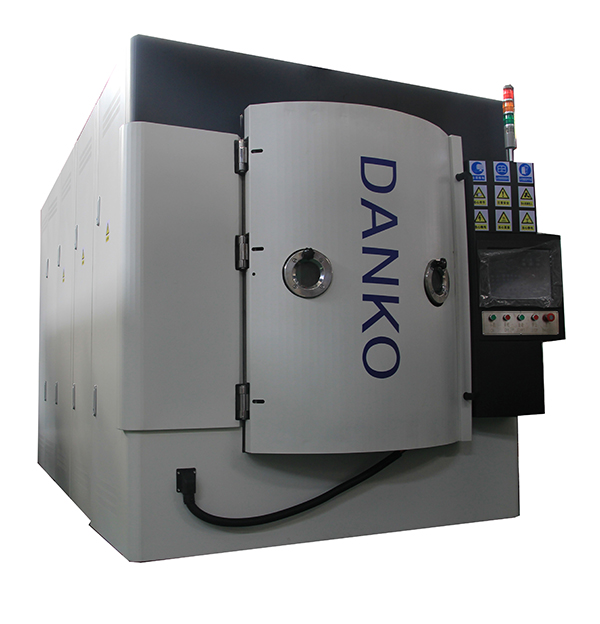
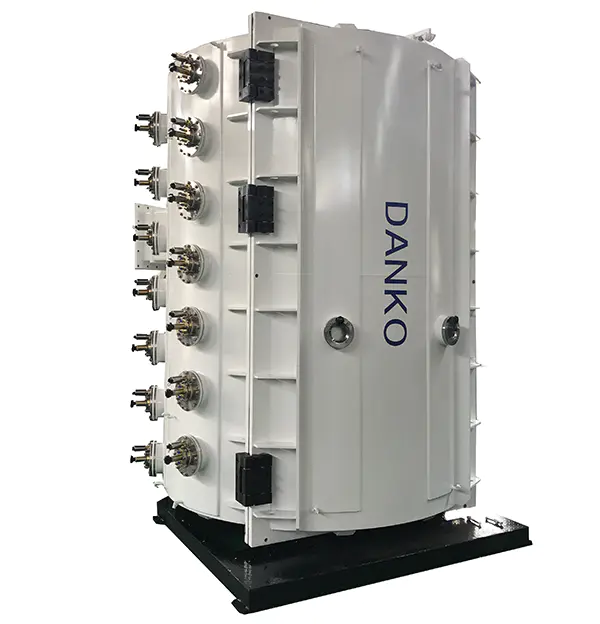
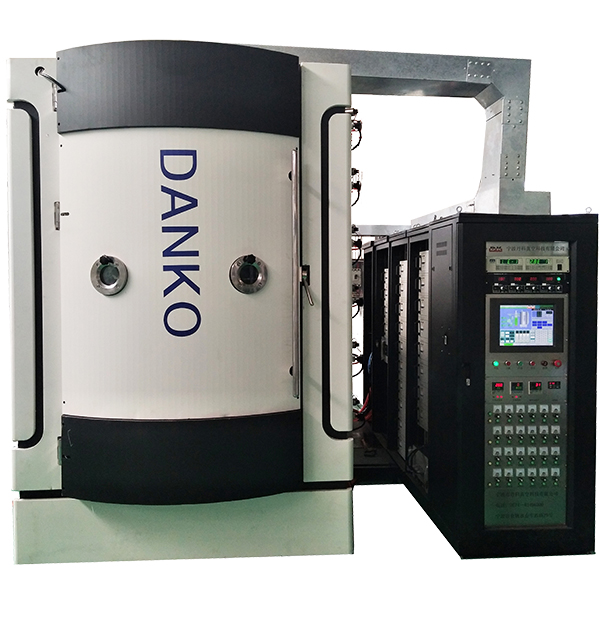
This hybrid machine is configured separately for each customer, so the following table should be read as a typical starting point. Ningbo Danko Vacuum Technology adjusts the number of arc and sputter sources, the chamber size and the pumping group to match the workpieces and production schedule.
| Item | Typical Configuration | Notes |
|---|---|---|
| Deposition Method | Hybrid cathodic arc evaporation and magnetron sputtering in one chamber | Each source can be run alone or together within the same coating recipe. |
| Chamber Layout | Vertical cylindrical chamber with front door, stainless steel, water cooled walls | Layout is designed for easy loading of tool trays and mould inserts. |
| Working Diameter | Typical range from 600 mm to 1,200 mm, larger sizes by project | A smaller chamber suits tool shops, while a larger one serves contract coaters. |
| Arc Sources | Two, four or six arc cathodes, titanium, chromium, zirconium or alloy | Arc power is used for adhesion layers and fast build-up of hard films. |
| Sputter Sources | Planar, cylindrical, twin or opposite magnetron targets | Used for smooth top layers, low friction films and fine colour control. |
| Target Materials | Titanium, chromium, zirconium, iron alloy and customer-specified alloys | Target size and bonding style are matched to the cathode design. |
| Pumping Group | Mechanical pump, Roots pump and holding pump with diffusion or molecular pump | A molecular pump gives cleaner vacuum and faster restart for tool coating. |
| Base Pressure | Usually better than 5 x 10⁻³ Pa, lower on request | Lower base pressure improves film purity for super hard coatings. |
| Heating and Etching | Radiant heaters to about 450 °C with ion etching and glow cleaning | Etching removes oxide and moisture to improve film bonding. |
| Bias Power | Pulsed DC bias with adjustable voltage and frequency | Allows control of ion bombardment, film density and residual stress. |
| Gas Control | Three or four mass flow channels for argon, nitrogen, acetylene and oxygen | Precise ratios support TiN, TiCN, TiAlN and TiCrN formation. |
| Fixture System | Planetary rotating carousel with tool holders or custom jigs | Fixtures are made for drills, taps, inserts, dies and automotive parts. |
| Film Thickness | About 1 to 6 micrometers for functional tool and mould coatings | Final thickness depends on tolerance and cutting application. |
| Control System | PLC and touch screen with recipe storage and process logging | Logging supports quality records for each coating batch. |
| Cooling and Power | Cooling water circuit, compressed air and three phase industrial power | Electrical standards follow the destination country. |
| After-Sales Support | Free 12 month warranty on the complete equipment, onsite service available | Service covers installation, repair, maintenance and training. |
If you already have a specific tool, die or part family, please send us the drawings or photographs. We will propose the cathode arrangement, fixture design and coating recipe, and confirm all parameters in the technical agreement before production starts.
Application
Hybrid arc and sputter coating is the practical choice when a part must be both hard and smooth. The applications below are where our customers most often put this machine to work.
-
Drills, taps and end mills. A TiAlN or TiAlCrN body with a sputtered top layer improves heat resistance and chip flow, allowing higher feed rates and longer tool life in steel and cast iron.
-
Broaches and gear cutters. Complex, expensive cutters gain a hard, adherent film that resists edge wear and built-up edge, which cuts regrinding cost and downtime.
-
Stamping dies and die cutting tools. Dense multilayer films reduce friction and galling on punches and dies, so stamping lines can run longer between maintenance stops.
-
Standard moulds and mould inserts. Coated cores, pins and cavities release parts more easily and resist corrosion from molten plastics and cooling water.
-
Pistons and piston rings. Low friction hard layers help engine components resist scuffing and wear, an important requirement in modern automotive engines.
-
Transmission and brake parts. Gears, shafts and brake components receive wear-resistant films that hold up under heavy load and repeated contact.
-
Precision mechanical parts. Bearings, valves and compressor components benefit from thin, hard and uniform coatings that preserve dimensional tolerance.
Customers also use the machine for decorative batches when tool coating orders are slow, which improves machine utilisation and return on investment.
Tool coating results depend heavily on pretreatment and fixture design, and this is where a manufacturer with real coating experience helps. Edges must be honed and cleaned, parts must be demagnetised where required, and fixtures must hold each tool at the correct angle to the cathodes. Danko engineers share fixture drawings and loading recommendations for common tool types, and can advise on regrinding and recoating cycles so that coated tools return to service with consistent performance.
Contract coating shops also value this machine because the hybrid layout lets them offer several coating grades to different customers from one chamber. A shop can produce a TiAlN grade for drilling, a CrN grade for forming tools and a decorative grade for hardware, simply by changing the target set, the gas recipe and the process time.
Advantage
A hybrid machine asks more of the manufacturer than a single-source machine, because arc power, sputter power and vacuum control must work together. The following strengths come from the way Danko designs and builds its systems.
-
Two processes, one chamber. Arc and sputter sources can be combined in a single recipe, so adhesion layers, hard bodies and smooth top layers are deposited in one pump-down.
-
Better surface quality. Sputtered layers cover or reduce macroparticles from the arc stage, giving a smoother film that suits cutting edges and sliding surfaces.
-
Flexible coating library. TiN, TiC, TiCN, TiAlN, TiAlCN, TiCrN and TiAlCrN are all possible, which lets a coating shop respond to many tool and part requests.
-
Efficient tool production. Fixtures and rotation systems are optimised for dense loading of tools, so each batch carries more parts without sacrificing uniformity.
-
Upgradable design. Extra cathodes, a larger pump set or additional gas channels can be added later, protecting the original investment as business grows.
-
Manufacturer-level engineering. Our team designs the chamber, controls and fixtures in-house, which means faster troubleshooting and tailor-made configuration instead of catalog compromises.
-
Complete support package. Free twelve month warranty, onsite installation, operator training and long-term target supply help customers keep production running.
These advantages are backed by more than fifteen years of vacuum coating equipment development, beginning in 2007 under the Huahong Vacuum Technology name.
Maintenance planning is built into the design. Access doors, shield layout and cathode mounting are arranged so that routine cleaning and target changes take little time, and process logging helps technicians see when a source needs attention before quality is affected.
Another practical benefit is process development. Because arc and sputter power can be adjusted independently, engineers can tune residual stress, hardness and colour for a specific job without changing the machine. Danko provides starting recipes for common tool and mould coatings, and our team supports customers who want to develop their own recipes for special steels or unusual part shapes.
For buyers who compare several offers, we suggest checking source count, pump configuration, bias supply capability and fixture quality, since these decide the real capacity of a hybrid machine.


 Tel: +86-13486478562
 FAX: +86-574-62496601
 Email:
 Address: No. 79 West Jinniu Road, Yuyao, Ningbo City, Zhejiang Provice, China
