
 Email:
 Tel:+86-13486478562

 Language
 Español
 Português
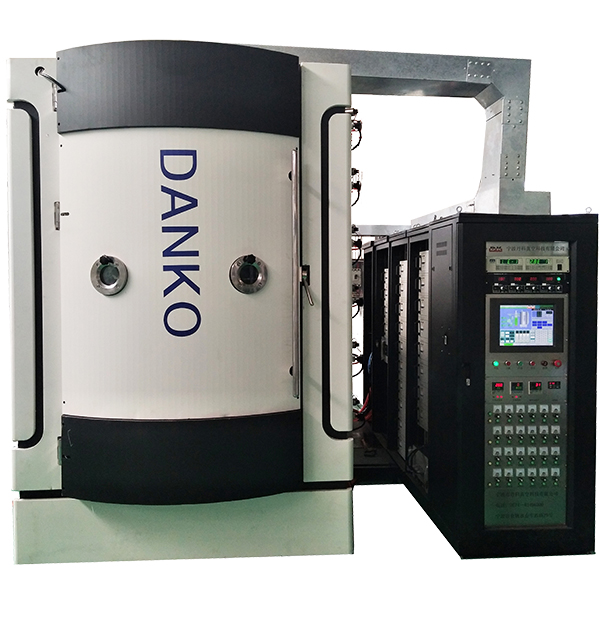

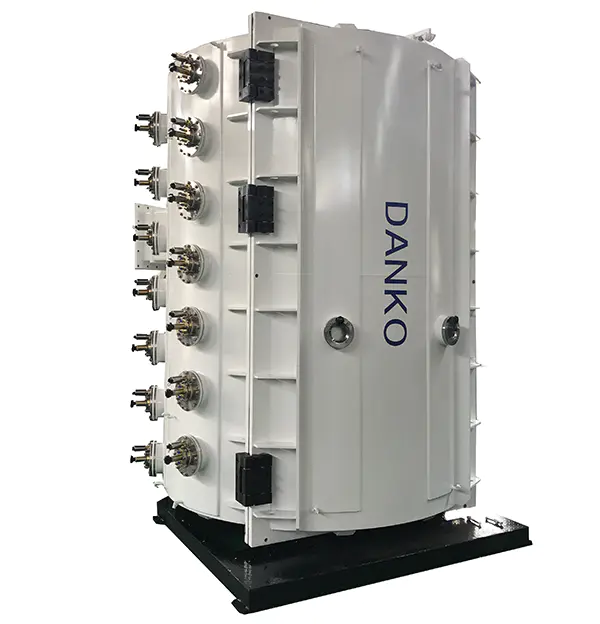

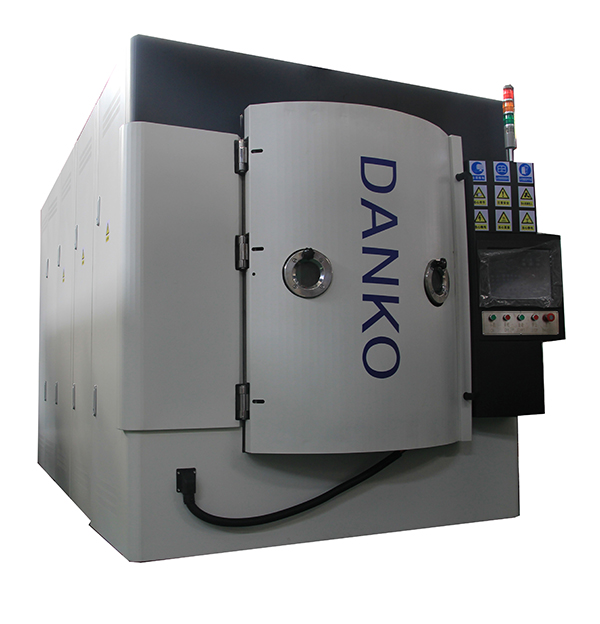
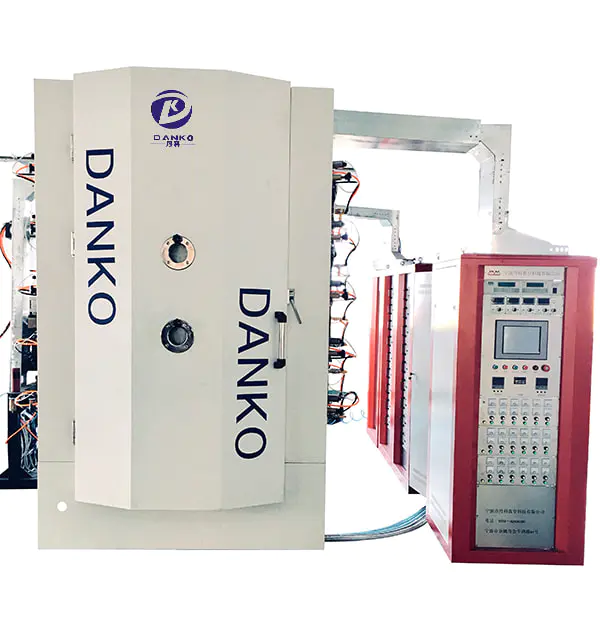


Specification
Medium-frequency sputtering configurations vary considerably depending on whether the line runs reactive oxides on glass and plastics or hard nitrides on metal components. The reference data below reflects our standard Yuyao build before customization to your part drawings and throughput.
| Item | Typical Configuration | Notes |
|---|---|---|
| Sputtering Mode | Twin-cathode medium-frequency (MF) magnetron sputtering, 20–80 kHz | Alternating polarity eliminates the "disappearing anode" effect during long reactive runs. |
| Cathode Geometry | Dual planar rectangular cathodes or twin cylindrical rotatable magnetrons | Cylindrical targets raise material utilisation above 75% for high-volume lines. |
| Target Materials | Ti, Cr, Zr, Si, Al, Sn, ZnAl, stainless steel and custom alloys | Targets are water-cooled directly or indium-bonded depending on thermal conductivity. |
| Chamber Format | Vertical cylindrical batch, horizontal box coater, or roll-to-roll web chamber | 304 or 316L stainless steel interior with electropolished finish and full water jacket. |
| Chamber Dimensions | Batch diameters 700 mm to 1,500 mm; web widths up to 1,600 mm | Target-to-substrate throw distance is tuned to part depth and step-coverage needs. |
| MF Power Supplies | 20 kW to 120 kW sine-wave or square-wave MF generators with fast arc handling | Independent power regulation per cathode pair allows graded refractive-index stacks. |
| Bias & Pre-Cleaning | Pulsed DC substrate bias (up to 1,000 V) plus linear anode-layer ion source | Ion source etching removes adsorbed water and activates polymer or glass surfaces. |
| Pumping Group | Rotary vane / dry screw pump + Roots blower + high-speed turbomolecular pump | Diffusion pump option available where heavy gas loads and lower capex are prioritized. |
| Base Vacuum | Better than 3 x 10⁻³ Pa (or 8 x 10⁻⁴ Pa with Meissner polycold trap) | Cryogenic water-vapour trapping cuts pump-down time on outgassing plastic loads. |
| Reactive Gas Control | 4 to 6 MFC channels (Ar, N₂, O₂, C₂H₂) with optional Plasma Emission Monitor (PEM) | PEM feedback keeps reactive deposition in the transition mode for 2–3x higher rate. |
| Thermal Management | Closed-loop radiant heaters up to 400 °C, or active chilled fixtures below 65 °C | Low-temperature mode prevents warping on PC, PMMA and ABS optical parts. |
| Substrate Motion | Double- or triple-axis planetary carousel; tension-controlled drum/free-span for film | Servo-driven indexing ensures ±2% thickness uniformity across the full height. |
| Layer Thickness | 10 nm optical interference layers up to 4 µm functional barrier or wear films | Sub-nanometre repeatability per pass via time, power-integral or optical monitoring. |
| Automation & PLC | Industrial PLC + 15-inch HMI with multi-step recipe editor and batch data export | Logs cathode voltage, current, partial pressures and cooling temperatures per run. |
| Site Utilities | 3-phase 380 V 50 Hz (or local grid), chilled water 18–22 °C, dry compressed air | Transformers and UL/CE-compliant electrical cabinets built to destination code. |
| Warranty & Spares | 12-month free warranty on complete equipment; long-term discounted consumables | Includes baseline recipes, onsite commissioning and operator maintenance training. |
Send us your substrate material, layer stack specification and target cycle time. Our vacuum engineers will model the cathode layout, pumping speed and power rating and include the locked-in specification sheet in your formal quotation.
Application
Medium-frequency sputtering earns its place whenever a coating recipe relies on reactive gases—oxygen, nitrogen or hydrocarbons—to form dielectric, optical or ultra-smooth compound films over long production shifts. Across our customer base, these machines are most commonly deployed in the sectors below.
-
Optical and anti-reflective glass. Alternating high-index (TiO₂, Nb₂O₅) and low-index (SiO₂) layers deposited by twin MF cathodes produce low-reflection display covers, camera lenses, architectural glass and solar collector coatings without dielectric arcing.
-
Automotive lighting and radar-transparent emblems. Polycarbonate headlamp bezels, LiDAR windows and front-grille badges receive non-conductive metallic-look indium, tin or chromium-oxide stacks that pass millimeter-wave radar signals without attenuation.
-
Sanitary ware and architectural hardware. Faucets, shower mixers and door levers gain dense, pinhole-free ZrN, TiN and dark carbon-nitride finishes with tight batch-to-batch ΔE colour tolerances required by European and North American brands.
-
Flexible barrier and optical PET films. Roll-to-roll MF sputter coaters deposit transparent AlOₓ and SiOₓ gas-barrier films for food and pharmaceutical packaging, as well as ITO or metallic conductive layers for touch sensors and window tints.
-
Consumer electronics and wearables. Watch bezels, smartphone mid-frames and laptop hinges in stainless steel, titanium or anodized aluminium take on scratch-resistant gunmetal, rose gold and ceramic-like black finishes.
-
Medical instruments and ceramic implants. Smooth, biocompatible TiN, ZrN and CrN coatings reduce glare on surgical tools and lower wear on ceramic-on-metal articulating surfaces without introducing arc droplets.
-
Precision tribological components. Fuel-injector needles, hydraulic plungers and textile guides benefit from low-friction, hydrogen-free carbon or CrN layers deposited at controlled temperatures so hardened steel tolerances never shift.
When a customer runs reactive oxide or nitride recipes for eight to twenty hours a day, conventional DC sputtering quickly hits the "disappearing anode" problem: insulating film coats the chamber shields until the plasma loses its ground reference and drifts. Twin-cathode MF sputtering eliminates that drift because the second cathode is continuously sputtered clean on every half-cycle, acting as a fresh, conductive anode from the first batch of the morning to the last batch of the night shift.
For shops coating 3D plastic parts or deep-draw metal housings, Danko pairs the MF cathodes with a linear ion source and optional Polycold water-vapour trap. Ion pre-treatment raises surface energy on polymers without thermal distortion, while rapid water-vapour pumping prevents porous, hazy films on humid shop floors.
If you are scaling up from an R&D box coater to multi-shift production, share your optical transmission curve, colour target or wear specification with our Yuyao lab—we can run sample coupons and verify adhesion and thickness uniformity before finalizing machine sizing.
Advantage
On paper, DC, pulsed-DC and MF sputtering look similar, yet on the shop floor their behaviour during reactive oxide and nitride runs is worlds apart. Buyers choose Danko MF sputtering systems for several practical engineering reasons.
-
Zero "disappearing anode" drift. Because each cathode in a twin-MF pair alternates as anode and target at 20–80 kHz, insulating build-up on chamber walls never chokes the discharge, keeping plasma impedance rock-steady over multi-day campaigns.
-
Arc-free dielectric deposition. Polarity reversal drains charge from target raceway borders before breakdown voltage is reached, preventing pinholes, spatters and target cracking during SiO₂, TiO₂ and Al₂O₃ runs.
-
Higher reactive deposition rates. Coupled with closed-loop plasma emission monitoring, MF cathodes operate stably in the metallic-to-compound transition zone, delivering 2 to 3 times the growth rate of poisoned-mode DC sputtering.
-
Dense, low-roughness microstructure. Higher plasma density and elevated ion-to-atom flux near the substrate pack atoms tightly without high bulk temperatures, yielding hard, pinhole-free films on both metals and polymers.
-
Balanced magnetic arrays for target economy. Our engineers tune NdFeB magnet packs to widen the erosion racetrack, cutting target waste and stretching intervals between costly target swaps—especially when running rotary cylindrical cathodes.
-
In-house mechanical and PLC integration. Ningbo Danko builds the chamber, cathode assemblies, gas manifold, fixtures and PLC software under one roof, so power supply interlocking and recipe ramping work seamlessly without third-party finger-pointing.
-
Complete lifecycle backing. Every machine ships with a 12-month free warranty, onsite commissioning, operator training and long-term access to targets, seals and shields at reduced prices.
Clean, effluent-free operation also simplifies factory permitting. Unlike hexavalent chrome electroplating or wet chemical anodizing, MF sputtering produces zero toxic wastewater, zero heavy-metal sludge and negligible airborne emissions, requiring only closed-loop cooling water, electricity, argon and reactive gases.
Serviceability is designed into the cathode mounting: quick-disconnect water couplings and removable dark-space shields allow a trained technician to swap planar or rotary targets and clean internal liners within a single shift change.
When comparing MF sputtering proposals, look closely at generator arc-energy clamp specs, magnet cooling efficiency and reactive gas response speed—these three details determine whether a machine runs smoothly in production or spends hours fighting plasma instability.


 Tel: +86-13486478562
 FAX: +86-574-62496601
 Email:
 Address: No. 79 West Jinniu Road, Yuyao, Ningbo City, Zhejiang Provice, China
